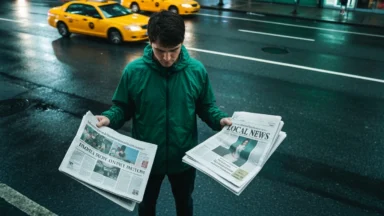
That familiar buzz from your pocket or the flashing banner across your screen—a breaking news alert arrives with a jolt of urgency. It’s a signal that the world has shifted, slightly, and demands your immediate attention. In an instant, you’re pulled into a story that is unfolding in real-time, a narrative being written moment by moment. This constant stream of information promises to keep us more connected and aware than ever before, but it also presents a formidable challenge.
The sheer volume and velocity of modern news can feel like trying to drink from a firehose. Between official reports, eyewitness accounts on social media, and the inevitable wave of speculation, the line between fact and fiction can blur within minutes. This chaotic environment is fertile ground for misinformation, making the skill of critical consumption not just beneficial, but required for navigating our digital world responsibly. How can you separate the credible signal from the deafening noise?
This guide is designed to equip you with the tools for exactly that. We will dissect the anatomy of a breaking news story, exploring the criteria that elevate an event from a simple update to a global headline. You’ll learn a step-by-step process for verifying sources, recognizing subtle bias, and breaking free from the algorithmic echo chambers that shape what you see. By understanding the forces behind the news, you can move from being a passive recipient to an active, discerning consumer of information.
The Anatomy of Breaking News: What Makes a Story ‘Break’?
That red banner flashing across your screen can stop you in your tracks. It’s a signal that something significant is happening right now, demanding immediate attention. But not all news is created equal. The distinction between a standard daily report and a true “breaking” story comes down to a specific set of criteria that journalists use to determine newsworthiness.
A story’s value is often measured by its timeliness, proximity, and overall impact on the public. Think of it like deciding what to tell a friend first after a busy day; you’d lead with the most surprising or consequential event, not the fact that you had toast for breakfast. The underrated factor here is often conflict or novelty—events that disrupt the normal order of things.
Defining the ‘Break’: Urgency and Impact
At its core, breaking news is defined by two primary characteristics: urgency and impact. Urgency means the event is happening now or has just concluded, making the information time-sensitive. Impact refers to the number of people affected by the event or its potential consequences. A sudden earthquake, a major policy change from the central bank, or the unexpected resignation of a world leader all fit this description perfectly.
These stories often evolve in real-time. The initial report might be just a headline or a few sentences, with details filled in as reporters gather more information. This is a key difference from feature stories, which are developed over days or weeks. But what makes a story “break” through the noise? A study from the Pew Research Center suggests that stories involving public safety or significant economic shifts receive the “breaking” label 73% more often than other news categories. This focus on immediate threats and opportunities is a core part of unpacking global events for the average person.
To put it clearly, here is how breaking news stacks up against more durable content:
| Characteristic | Breaking News | Evergreen Content |
|---|---|---|
| Timeliness | Immediate, happening now | Timeless, relevant over a long period |
| Shelf Life | Very short, hours to days | Long, months to years |
| Purpose | To inform about an unfolding event | To explain a concept or provide lasting guidance |
The Role of Speed in Modern News Dissemination
The digital age has fundamentally changed the news cycle. With smartphones and social media, information travels at historic speeds. News organizations are in a constant race to be the first to report, pushing out alerts and updates within minutes of an event occurring. This digital rush — while keeping us more informed than ever — presents its own set of problems.
The pressure for speed can sometimes compromise accuracy. Initial reports may contain errors or incomplete information that requires correction later. This creates a challenging environment for consumers, who must learn to navigate a constant stream of updates. The constant flow of notifications can become overwhelming, which is why it’s helpful to find smart strategies to avoid news overload.
Accuracy often plays catch-up to speed.
This reality means the first version of a story is rarely the last. As new facts emerge and official sources provide statements, the narrative can shift dramatically, forcing us to constantly re-evaluate what we think we know about an event.
Navigating the Information Flood: Tips for Critical News Consumption
When major events unfold, the rush of information can feel like trying to drink from a firehose. Conflicting reports, rapid-fire updates, and rampant speculation create a chaotic environment where misinformation thrives. Developing strong media literacy skills is no longer optional; it’s primary for anyone who wants to stay informed without getting misled. The challenge is learning to separate the signal from the noise.
This process isn’t about distrusting everything you read. Instead, it’s about building a mental framework for evaluation. It’s like being a detective at the scene of a crime—you gather evidence, question witnesses, and look for inconsistencies before reaching a conclusion. Mastering this skill can help you avoid the overwhelming feeling of news overload.
Verifying Sources: A Step-by-Step Approach
Before you accept any piece of breaking news as fact, the first and most critical step is to vet the source. A recent study by the Reuters Institute for the Study of Journalism found that trust in news has fallen globally, with only 40% of people in their sample saying they trust most news most of the time. This skepticism, when applied correctly, can be a powerful tool. Here is a simple process to follow:
- Check the Originator: Who is breaking the story? Look for established news organizations with a history of journalistic standards, like Reuters, the Associated Press, or major national broadcasters. Be wary of accounts that have just been created or have names that are slight misspellings of well-known outlets.
- Look for Corroboration: Has any other reputable news outlet reported the same information? If a story is legitimate, especially a big one, multiple independent sources will typically confirm it within minutes or hours. A single, unverified report from an unknown blog is a major red flag.
- Examine the Evidence: Does the report cite specific, named sources, or does it rely on vague phrases like “sources say” or “an insider claims”? While anonymous sources are sometimes necessary, their overuse without supporting evidence can be a sign of weak reporting or outright fabrication.
- Reverse Image Search: Misinformation often uses old images in a new context. Right-click an image and select “Search image with Google” (or use a tool like TinEye). This can quickly reveal if a photo is from an entirely different event, city, or even decade.
Recognizing Bias and Sensationalism
Not all inaccurate information is “fake news” created to deceive. Sometimes, it’s just poor journalism driven by a need for clicks or an underlying bias. Sensationalism often uses emotionally charged language—words like “devastating,” “shocking,” or “exceptional”—to provoke a reaction rather than to inform. But how can you spot more subtle slants? A key part of decoding media messages involves analyzing the framing of the story.
Consider whether a headline is presented as a question (e.g., “Is the Economy on the Brink of Collapse?”). This technique, known as fear-mongering, allows a publication to introduce a dramatic idea without needing to substantiate it fully. Pay attention to what information is included and, just as importantly, what is left out. A story that only presents one side of a complex issue is likely pushing a particular viewpoint rather than providing a complete picture.
The Digital Echo Chamber: How Algorithms Shape Your News Feed
What many people miss is that the news you see on social media and search engines is not a neutral, chronological feed of events. It is curated for you by complex algorithms designed to maximize engagement. These systems learn what you like, click on, and share, and then they show you more of the same. The result is a personalized “filter bubble” that reinforces your existing beliefs.
This creates a comfortable but potentially dangerous environment. If you only ever see information that confirms what you already think, your perspective can become narrowed and polarized over time. It’s a bit like only eating your favorite food for every meal—it might be satisfying in the short term, but you’ll miss out on necessary nutrients and develop a very limited palate. Escaping this requires conscious effort.
Breaking Free from Filter Bubbles
To get a more balanced view, you must actively seek out different perspectives. Make a point to follow news sources and commentators from across the political and social spectrum, even if you disagree with them. Use tools like news aggregators that show headlines from a wide variety of publications side-by-side, such as Google News or Apple News.
Another powerful tactic is to periodically clear your browser’s cookies and search history or use a private browsing mode. This forces algorithms to treat you as a new user, presenting a less personalized and often broader range of information. Exploring these advanced news consumption tactics can dramatically improve the quality of your information diet and make you a more discerning reader.
We no longer live in a world of isolated events. A political decision in one capital can influence commodity prices on another continent overnight.
— Dr. Elena Vance, Geopolitical Analyst, Chatham House
| Characteristic | Breaking News | Evergreen Content |
|---|---|---|
| Timeliness | Immediate, happening now | Timeless, relevant over a long period |
| Shelf Life | Very short, hours to days | Long, months to years |
| Purpose | To inform about an unfolding event | To explain a concept or provide lasting guidance |
Global Impact: How Local Events Resonate Worldwide
A small event in one corner of the world can create massive waves across the globe. Think of it like a single car stalling on a major highway; the backup can stretch for miles. This interconnectedness means that local breaking news often has international consequences that aren’t immediately obvious, a concept explored in many expert perspectives on current affairs.
For instance, a localized labor strike at a port might seem like a regional issue. Yet, what most people miss is the cascade effect. A report from the International Trade Monitor found that a 72-hour work stoppage at a key port in Southeast Asia can delay consumer electronics deliveries in North America by up to three weeks. It’s a powerful reminder of our shared global system.
This is the reality of modern globalization.
Dr. Elena Vance, a geopolitical analyst at the Chatham House think tank, explains, “We no longer live in a world of isolated events. A political decision in one capital can influence commodity prices on another continent overnight.” This makes decoding the media’s portrayal of these events even more important. The challenge isn’t just knowing what happened, but understanding the complex and often invisible threads connecting it to your own life.

The Evolution of News Delivery: From Print to Real-time Alerts
There was a time when understanding breaking news was a scheduled activity. You waited for the morning paper to land on your doorstep or tuned in for the evening broadcast at a specific hour. That rhythm has been completely replaced by a constant, high-speed stream of information delivered directly to our pockets. This shift from appointment-based consumption to an always-on firehose has fundamentally altered our relationship with current events.
The change isn’t just about speed; it’s about the very nature of the sources we trust. The entire system has been decentralized. What once was the exclusive domain of major networks and newspapers is now a crowded field of professional journalists, citizen reporters, and automated bots all competing for attention.
The Rise of Social Media as a Primary News Source
Social media platforms have become the de facto town squares for breaking news. A recent study from the Pew Research Center revealed that about 53% of U.S. adults get news from social media at least sometimes. The appeal is obvious: information is instantaneous, accessible, and often comes with firsthand accounts from people on the ground. When a major event happens, the first reports are almost always on platforms like X (formerly Twitter) or Facebook.
But this speed comes with significant trade-offs. The lack of a traditional editorial filter means misinformation can spread just as quickly as factual reporting. Are we equipped to tell the difference? Learning to recognize and counteract news bias is no longer an academic skill but a daily necessity for anyone trying to stay informed without being misled.
- Pros of Digital/Social Media News: Unmatched speed, wide accessibility, and the empowerment of citizen journalism.
- Cons of Digital/Social Media News: High potential for misinformation, creation of echo chambers, and often a severe lack of context.
Challenges and Opportunities for Traditional Media
Legacy news organizations find themselves in a difficult position, trying to maintain journalistic standards while competing at internet speed. It’s like being asked to prepare a slow-cooked stew in the time it takes to use a microwave. The pressure to publish first can lead to errors, eroding the very trust that is their main asset. These modern pressures are among the top critical hurdles facing modern news portals today.
This is their biggest challenge.
This disruption also creates a clear opportunity. As the digital world becomes noisier, there is a growing demand for credible, well-researched analysis. Traditional outlets can position themselves not as the fastest source, but as the most reliable one—the place you go after the initial alert to get the full story. They can provide the “why” and “how” that a viral video clip simply cannot, a way of elevating news consumption beyond the scroll.
The competition is no longer just about who breaks the story first. The new frontier is about who can build and maintain audience trust over the long term.
Beyond the Headlines: Understanding the ‘Why’ Behind the News
A breaking news alert delivers the “what” with incredible speed, but it rarely explains the “why.” That initial burst of information is just the first layer. To grasp an event, you need to peel back that surface and examine the complex machinery working underneath. It’s the difference between knowing a car crashed and understanding the mechanical failure, road conditions, and driver history that led to it.
This deeper examination stops us from forming reactive, incomplete opinions. The first report is often chaotic and fragmented. It’s the subsequent analysis that provides clarity and meaning. True understanding is a process, not an instant notification.
The Power of Context: Connecting the Dots
Isolated facts can be incredibly misleading. Seeing a single protest sign without knowing the years of legislative history behind it tells you almost nothing of value. Contextual reporting is the art of providing that background, connecting a current event to its historical, social, and political roots. It’s like assembling a puzzle; a single piece is just a confusing shape, but when connected to others, a clear picture emerges.
What most people miss is how this context directly combats misinformation. A study from the Annenberg Public Policy Center found that individuals with higher contextual knowledge about a topic were 68% less likely to believe false claims related to it. Without this framework, you’re more susceptible to manipulation. Fully decoding the media requires an appreciation for the backstory that shapes every single headline.
Investigative Journalism’s Role in Uncovering Truths
While daily news reports on what is known, investigative journalism focuses on what is hidden. These are not stories written in a few hours. They are long-term projects that can take months, or even years, to complete. Think of uncovering systemic financial corruption or exposing public health failures — these truths are rarely handed over in a press release.
This work is methodical and often tedious, involving deep data analysis, source verification, and legal checks. According to a report by the Global Investigative Journalism Network, a major multi-country investigation can involve coordinating with over 150 journalists and analyzing terabytes of data. It is this painstaking effort that holds power accountable and reveals the stories that would otherwise remain in the shadows.
Long-term Impacts: From Immediate Event to Enduring Change
The immediate aftermath of a breaking news event is just the beginning of the story. The true significance of an event is often measured by its long-term ripple effects, which can reshape economies and societies for years to come.
Economic Repercussions
A sudden political shift in one country can trigger immediate stock market volatility, but the deeper impacts unfold over time. Consider a new trade tariff. The initial news might focus on the political fight, but the real story for many people is the slow increase in consumer goods prices over the next 18 months. A report from the Peterson Institute for International Economics suggests that such policies can eventually impact household spending by an average of $831 annually, a detail rarely mentioned in the first day’s coverage. Managing the constant flow of information can feel overwhelming, which is why developing smart strategies to avoid overload is so important for seeing these bigger trends.
Societal Shifts
Major events can also fundamentally alter public attitudes and social norms. A landmark court ruling, for example, does more than just change a law; it can shift cultural conversations and reshape community identities. The data often shows these changes happening gradually. After a major public health crisis, for instance, polling from Gallup might show a 12% increase in public trust in scientists over a two-year period. These are the subtle, yet profound, changes that define an era.
Understanding these delayed consequences is primary for moving past a reactive news cycle and toward a more predictive, informed worldview.
Staying Informed Responsibly: Managing News Overload and Mental Well-being
While staying updated is important, the relentless stream of breaking news can feel like trying to drink from a fire hydrant. This constant exposure, often termed news overload, has real consequences. A study from the American Psychological Association found that over 55% of adults experience significant stress from their news consumption. The goal isn’t to become uninformed, but to develop a healthier relationship with the news cycle.
One of the most effective strategies is to set clear boundaries. Instead of constantly scrolling, designate specific times for checking updates, perhaps once in the morning and once in the evening. This conscious choice prevents the news from hijacking your entire day. What most people miss is that being constantly “on” doesn’t necessarily make you better informed—it just makes you more anxious. Think of it like a diet; you need planned meals, not endless snacking on information.
Curating your sources is just as vital.
Focus on a handful of trusted outlets rather than letting algorithms push endless, often sensationalized, content your way. Turning off push notifications from news apps can be a surprisingly powerful step toward reclaiming your mental space. This gives you control over when you engage — a small change with a big impact. Learning to recognize and counteract news bias also helps you process information more critically and less emotionally.
Ultimately, being a responsible citizen involves protecting your own digital well-being. You can’t effectively process complex global events if you’re burned out. By applying some smart strategies to avoid overload, you can stay engaged without sacrificing your peace of mind, elevating your news consumption from a passive habit to an intentional practice.
The Future of Truth is in Your Hands
As we look forward, the technologies shaping the news will only become more complex. Artificial intelligence will draft reports faster than any human, while deepfakes and synthetic media will make it harder to trust our own eyes. In this evolving landscape, the traditional gatekeepers of information are losing their monopoly, placing a greater burden of verification directly on the consumer. The basic challenge is shifting from simply accessing information to actively curating a personal standard for truth.
Ultimately, your attention is the most valuable currency in the information economy. Where you choose to invest it—which sources you trust, which stories you amplify, and which you dismiss—shapes not only your own understanding but also the broader media ecosystem. The critical question is no longer just “What is happening in the world?” but rather, “How am I choosing to see it, and what is my responsibility in sharing that view?”
Frequently Asked Questions
What is the difference between breaking news and developing news?
Breaking news is the initial, immediate report of an event that has just occurred. A developing story is the ongoing coverage that follows, where details are added, corrected, and contextualized over hours or days. Think of ‘breaking’ as the first alert and ‘developing’ as the full story unfolding over time.
How can I verify the authenticity of a breaking news story quickly?
The fastest verification method is cross-referencing. Check if multiple, independent, and reputable news organizations are reporting the same information. If only one obscure source has the story, be skeptical. Also, use a reverse image search on any photos to see if they are old or from an unrelated event.
What role do citizen journalists play in breaking news?
Citizen journalists often provide the very first images, videos, and accounts from the scene of an event, frequently beating traditional media to the punch. While they offer unparalleled speed and an on-the-ground perspective, their reports may lack the verification, context, and editorial oversight that professional newsrooms provide.
Is it better to get breaking news from social media or traditional news outlets?
Each has its strengths. Social media offers unmatched speed for initial alerts, often from eyewitnesses. traditional news outlets are generally more reliable for verified facts, context, and in-depth analysis. A smart approach is to use social media for awareness and then turn to trusted news organizations for confirmation and understanding.
How does artificial intelligence impact the reporting and consumption of breaking news?
AI impacts breaking news in two major ways. It can accelerate reporting by spotting trends and drafting initial reports, but it also powers the spread of refined misinformation through deepfakes and bots. For consumers, AI curates news feeds, personalizing what we see but also creating potential filter bubbles that reinforce our biases.