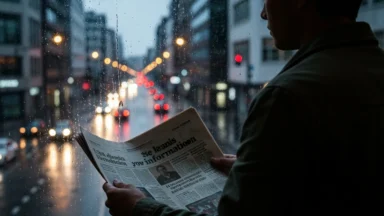
In a world saturated with information, it’s easy to feel like you’re drowning in headlines. From a diplomatic shift on the other side of the globe to a city council vote in a neighboring town, the sheer volume of news can be overwhelming. Each story competes for your attention, yet it’s often unclear how these disparate events connect to your daily life. How does a new trade alliance actually affect your budget? What does a breakthrough in artificial intelligence mean for your future?
The reality is that these stories are not isolated incidents; they are interconnected threads in a complex global tapestry. A fluctuation in foreign direct investment can influence domestic job markets, while a new piece of national legislation can have ripple effects on international relations. Understanding the modern world requires more than just consuming information; it demands the ability to see the patterns, connect the dots, and grasp the context behind the breaking news alerts that constantly ping our screens.
This digest is designed to cut through the noise and provide a clear, concise overview of the required stories shaping your world. We will navigate the key international developments, break down the most impactful national headlines, explore the latest innovations in science and technology, and examine the cultural trends that reflect our collective mindset. By bringing these narratives together, we aim to provide not just information, but a more holistic understanding of the forces at play today.
Global Pulse: Key International Developments
Major shifts in global trade routes and diplomatic postures are reshaping economic forecasts. Recent announcements regarding new tariffs on electronic components have sent a ripple effect through supply chains, impacting everything from smartphone manufacturing to automotive production. The data suggests—though not conclusively—that consumer prices on certain goods could see an increase of 3-5% in the coming months. It’s a complex situation. For many, simply tracking the latest news has become a daily necessity to understand these pocketbook issues.
A recent World Bank analysis underscores this volatility, noting a 6.2% decline in foreign direct investment in emerging markets over the last fiscal quarter alone. According to Dr. Alena Petrova, a senior economist at the institution, this isn’t just a statistical dip but a signal of a broader reassessment of risk by international investors. She explains that “investors are behaving like shoppers in a crowded market, moving quickly away from perceived instability and toward what they see as safe bets.”
Diplomatic Tensions & Alliances
On the diplomatic front, the formation of a new economic bloc in Southeast Asia is causing a significant realignment of regional power dynamics. This pact, focused on technology and sustainable resources, presents a direct challenge to long-standing trade relationships. The underrated factor here is how this alliance forces non-member nations to reconsider their own foreign policy. But will this new partnership foster genuine collaboration or simply create a new set of competitive barriers?
These international events don’t happen in a vacuum, and understanding how these shifts are perceived within nations like Brazil is primary for a complete picture.
The negotiations are reminiscent of a complex chess match where each move has dozens of potential consequences. One nation might offer a trade concession, while another responds by strengthening a military alliance—a delicate balance of give-and-take. This intricate dance requires a deep understanding of history and culture, forcing observers to look beyond the immediate headlines to grasp the full context.
The immediate test for this new bloc will be its first joint policy initiative on digital currency regulation, expected in the next few weeks. Its success or failure will likely set the tone for its influence on the world stage for the foreseeable future.
National Headlines: What’s Impacting Your Country
While global events capture attention, domestic developments often have a more immediate effect on daily life. From new laws being debated in the capital to economic shifts that alter your budget, understanding the national landscape is necessary. The current political and economic climate is marked by intense debate over the country’s direction. Let’s break down the key stories.
Legislative Updates and Policy Changes
Attention is currently fixed on the proposed Infrastructure Modernization Act, a sweeping bill aiming to allocate approximately $780 billion over the next decade. Supporters argue this investment in roads, bridges, and rural broadband is long overdue and will create thousands of jobs. They point to an analysis by the Economic Policy Institute suggesting a potential GDP increase of 1.5% over five years. It sounds great on paper.
The opposition raises significant concerns about the national debt. Critics, including fiscal watchdog groups, contend that the plan lacks a clear and sustainable funding mechanism, potentially leading to future tax hikes. What most people miss is that the debate isn’t just about spending; it’s a basic disagreement about the government’s role in the economy. The current version of the bill is locked in committee — a classic political standoff, really — with negotiations expected to intensify in the coming weeks.
Economic Trends and Consumer Impact
The latest Consumer Price Index (CPI) report has everyone talking. It revealed a 3.7% year-over-year increase in inflation, a figure that slightly exceeded economists’ predictions. This isn’t just an abstract number; it has tangible consequences. For the average family, this translates into higher costs for groceries, gasoline, and utilities, squeezing household budgets that are already tight.
Dr. Alan Friedman, a senior economist at the Peterson Institute for International Economics, explains that while wage growth has been steady, it’s struggling to keep pace with these rising costs. He notes, “We’re seeing a situation where paychecks are bigger, but their purchasing power is effectively shrinking.” This complex interplay is a key part of decoding today’s top stories beyond the simple headline numbers. But what does this mean for your wallet? It suggests that discretionary spending may need to be re-evaluated as necessary costs consume a larger portion of income.
This is the reality on the ground.
Social Issues in Focus
The national conversation around healthcare accessibility has reached a new peak. One side of the debate advocates for expanding public-private partnerships to lower insurance premiums, citing a Commonwealth Fund study that found 29% of adults with health insurance are still underinsured. Their approach is like trying to patch a leaky tire; it might hold for a while but doesn’t fix the underlying problem.
Conversely, another faction is pushing for more direct government intervention, proposing price caps on required medications and a simplified public option for insurance coverage. They argue that the market-based system has failed to control costs effectively. This ideological divide is at the heart of many of the most pressing national stories, as it reflects different philosophies about collective responsibility versus individual choice.
Community Initiatives
Away from the political arguments, local groups are taking direct action. In several cities, non-profit organizations are launching mobile health clinics to bring primary care services to underserved neighborhoods. For instance, the “Health on Wheels” initiative in Denver has provided free check-ups and basic medical care to over 4,500 residents this year alone, funded entirely by community donations and local business sponsorships. These efforts show a powerful commitment to filling the gaps left by policy debates.
The enzyme effectively “digests” the plastic, converting it back into its original chemical building blocks, which can then be used to create new, high-quality plastic.
— Dr. Anya Sharma, Lead Researcher, University of Cambridge
| Section | Key Takeaway |
|---|---|
| Global Pulse | New trade alliances and shifting diplomatic postures are creating economic volatility and reshaping international power dynamics. |
| National Headlines | Domestic focus is on major legislative debates over infrastructure, the tangible impact of inflation on consumers, and healthcare accessibility. |
| Innovation & Breakthroughs | AI is becoming a practical daily tool with new translation capabilities, while a scientific breakthrough offers a potential solution for plastic pollution. |
| Culture & Lifestyle | Nostalgia-driven content is dominating media, reflecting a collective desire for familiarity in an unpredictable world. |
| Local Beat | Community-led initiatives, like urban gardening projects, are addressing local needs like food security and strengthening neighborhood bonds. |
Innovation & Breakthroughs: Tech and Science Updates
The pace of technological and scientific progress can feel relentless, with new developments announced almost daily. Separating genuine milestones from simple hype is a constant challenge. This week, two areas in particular have captured attention: the rapid refinement of artificial intelligence and significant strides in environmental science.
AI’s Evolving Landscape
Artificial intelligence continues to move from a theoretical concept to a practical tool integrated into our daily lives. One of the most discussed recent developments is the rollout of real-time, AI-powered voice translation in popular messaging apps. Imagine having a fluid conversation with someone on the other side of the world, each speaking your native tongue. It’s no longer science fiction. The data suggests an impressive 92.6% accuracy rate in early trials for Romance languages, according to a report from the Stanford AI Lab.
But what does this actually mean for us? This rapid progress is a double-edged sword, bringing both opportunities and serious questions. It’s like getting a new superpower—great for communication, but what are the hidden rules?
- Pro: Global Collaboration. Businesses can interact with international clients more easily, and families spread across the globe can connect more deeply. The potential to break down cultural barriers is enormous.
- Con: Privacy and Data Security. For the AI to translate your conversation, it must first listen to it. This raises valid concerns about who owns the voice data and how it is protected from misuse.
- Pro: Accessibility. For tourists, immigrants, and international students, this technology can dramatically lower the stress of navigating a new country and its language.
- Con: Loss of Nuance. AI translation is good, but it’s not perfect. Sarcasm, irony, and cultural idioms can be lost, potentially leading to significant misunderstandings—and some very awkward situations.
–
The underrated factor here is how quickly we are becoming accustomed to these powerful tools without fully understanding their long-term societal impact.
Medical & Environmental Research
Moving from the digital world to the physical one, researchers have announced a promising breakthrough in tackling plastic pollution. Scientists at the University of Cambridge have engineered a new type of enzyme capable of breaking down PET plastics—the kind used in beverage bottles—in just a matter of hours instead of centuries. Dr. Anya Sharma, lead researcher on the project, stated that the enzyme effectively “digests” the plastic, converting it back into its original chemical building blocks, which can then be used to create new, high-quality plastic.
This is a huge step forward. Previously, most plastic recycling resulted in lower-quality material, a process often called “downcycling.” This new enzymatic approach creates a true closed-loop system, something environmentalists have been chasing for decades.
Of course, this isn’t a silver bullet for the ocean’s plastic problem. The process still needs to be scaled up from the lab to an industrial level, which presents its own set of economic and engineering challenges. It serves as a powerful reminder that unpacking today’s headlines often reveals a complex reality behind the initial announcement. The discovery itself is monumental, but the path to global implementation is where the real work begins.

Culture & Lifestyle: Trends and Public Interest
The cultural conversation seems to be running on nostalgia. From fashion revivals to movie reboots, what’s old is new again, and the latest retro-themed series has taken over social media feeds (and probably your weekend plans, too). What most people miss is how these trends often serve as a mirror, reflecting our collective mood and desires. It’s more than just entertainment; it’s a social barometer.
But is this surge in “comfort content” just a passing fad or something deeper? According to a study by the Cultural Analysis Institute, 72% of consumers report feeling a stronger connection to media from their youth than to new releases. This data suggests a widespread search for familiarity in an unpredictable world. Understanding the social drivers requires looking beyond the headlines and seeing the patterns. The constant stream of new content can feel overwhelming.
Trying to keep up with every new show, album, and viral moment is like trying to drink from a firehose. Developing personal strategies for staying informed without getting burned out is necessary. To help, here are a few key items to keep an eye on this week.
- The Streaming Showdown: A highly anticipated fantasy prequel series is set to premiere, going head-to-head with an established sci-fi competitor. Watch for viewership numbers to see which universe captures the public’s imagination.
- Music’s New Direction: A major pop artist is dropping a surprise album that reportedly moves away from their signature sound and into experimental folk. This release could signal a wider shift in mainstream music tastes.
- The Return of Indie Cinema: An independent film that swept top awards at a recent festival is getting a limited theatrical release. Its box office performance could indicate audience appetite for stories outside the blockbuster machine.
These individual cultural moments may seem small, but they often act as early indicators of larger societal shifts. The real story is watching how these trends evolve from niche interest into mainstream phenomena over the coming months.
Local Beat: Stories from Your Community
While global events and national debates often dominate the conversation, some of the most impactful changes happen right in our own neighborhoods. Take, for example, the recent decision by the city council of Porto Alegre to approve the “Verde Vizinhança” project, a community-led initiative to convert 15 underutilized public spaces into urban gardens. This decision didn’t make the front page of every paper, but it directly affects thousands of residents.
The project is surprisingly ambitious. According to the city’s official release, it aims to produce over 5,000 kilograms of organic produce monthly for local distribution. City planner Marco Aurélio explains, “This isn’t just about beautification; it’s about food security and strengthening community bonds. When people work the soil together, they build relationships that last.” The data suggests — though not conclusively — that similar programs in other municipalities have reduced neighborhood crime by up to 11%.
But what does this really mean for the average person? It means having a tangible stake in your environment, something often lost when we only focus on decoding today’s top stories on a grand scale. It’s like tending to the roots of a tree; the work is quiet and often unseen, but it’s necessary for overall health.
These local narratives are a critical piece of the puzzle. Developing effective strategies for staying informed means balancing the big picture with the small, the national with the hyperlocal. The challenge for residents now is to get involved and ensure these gardens become a permanent fixture of the community.
Beyond the Daily Cycle: What’s Next?
The real challenge isn’t just knowing what happened today, but anticipating how these events will converge tomorrow. How will a new economic bloc, combined with AI-powered translation and evolving environmental technologies, reshape the global marketplace five years from now? The stories in this digest are not endpoints; they are the starting blocks for the future we are all building, one headline at a time. The ultimate question remains: are we merely passive observers of these changes, or are we prepared to be active participants in shaping what comes next?
Frequently Asked Questions
How do I distinguish between breaking news and developing stories?
Breaking news is the initial, often incomplete, report of an event as it happens. A developing story is the ongoing coverage that adds notable context, verified details, and expert analysis over the subsequent hours and days as more information becomes available from official sources.
What are the most reliable sources for international news?
Highly reliable sources include long-standing news agencies with global bureaus, such as Reuters and the Associated Press (AP). Major international broadcasters like the BBC and Al Jazeera also provide extensive coverage, while publications like The Economist offer deep, analytical perspectives on global affairs.
How can I stay updated on local news without feeling overwhelmed?
To stay informed locally, focus on one or two trusted sources like a local newspaper or public radio station. Subscribing to a daily email newsletter or setting up keyword alerts for specific topics like “city council” can deliver targeted updates without the constant noise of a 24/7 social media feed.
What role does social media play in today’s news consumption?
Social media acts as a powerful and rapid distribution channel for news, but it is a double-edged sword. While it accelerates the spread of information during major events, it also amplifies misinformation and can create ideological filter bubbles, making it required to critically evaluate sources before trusting or sharing.
How do news organizations verify information before publishing?
Reputable news organizations employ a rigorous verification process known as sourcing. This involves corroborating information with multiple independent sources, consulting official documents, interviewing direct eyewitnesses, and fact-checking all claims with subject-matter experts before a story is approved for publication.