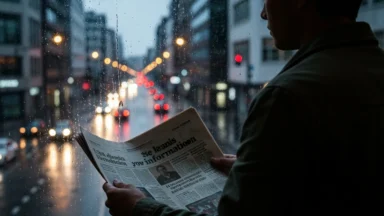
In an era defined by the constant glow of screens, our relationship with the news has been fundamentally reshaped. The predictable daily cycle of newspapers and evening broadcasts has given way to a relentless, 24/7 stream of information, alerts, and updates delivered directly to our pockets. This digital deluge offers historic access to global events as they unfold, but it also creates a chaotic environment where fact, fiction, and opinion collide with dizzying speed.
This shift from curated media to algorithmic feeds has profound consequences. A recent Pew Research Center study revealed that over 70% of adults now consume at least some news via social media, where content is personalized based on past behavior. While this can feel convenient, it often traps us in ‘filter bubbles’ or ‘echo chambers,’ reinforcing our existing beliefs and shielding us from different viewpoints. The result is the erosion of a shared informational ground, making it harder to engage in productive public discourse.
Navigating this complex landscape requires more than passive consumption; it demands a new set of critical thinking skills. How can you distinguish a credible source from a cleverly disguised agenda? What is the difference between biased reporting and outright misinformation? This guide provides a practical framework for decoding today’s top stories. We will explore how to vet sources, understand the key role of context, recognize subtle forms of media bias, and ultimately move from being an overwhelmed reader to an empowered and informed citizen.
The Evolving Landscape of News Consumption
The ritual of sitting down with a morning newspaper or tuning into the evening broadcast has been fundamentally replaced by the constant, glowing screen in our pockets. Not long ago, news arrived in predictable cycles, like a scheduled commuter train. Today, it’s a non-stop, 24/7 superhighway of information, alerts, and updates, completely altering our relationship with notícias atualizadas (updated news).
This massive shift is driven primarily by digital platforms. A recent study from the Pew Research Center highlights this change, indicating that a staggering 71% of adults now get at least some of their news from social media sites. Information that once took hours or days to disseminate now spreads globally in minutes. This speed offers historic access but also introduces new complexities — and let’s be honest, a lot more noise.
The real change isn’t just the medium; it’s the entire experience.
With algorithms curating our feeds, our news intake is becoming increasingly personalized, for better or worse. What does this mean for a shared public understanding of events? The underrated factor here is the erosion of a common informational ground, where everyone was at least reading from the same front page. Navigating this new environment requires more than just passive reading; it demands active critical thinking and a solid framework for unpacking today’s headlines. Without these skills, it’s easy to get lost in a sea of conflicting reports or fall prey to a continuous cycle of outrage, a problem compounded by the hidden costs of constant global news consumption.
Ultimately, this evolution forces us to become more discerning consumers, questioning sources and seeking out diverse perspectives. The responsibility has shifted from the editor’s desk directly to the individual user, a trend that shows no sign of slowing down.
Identifying Credible Sources in a Flood of Information
The sheer volume of information available today can feel like trying to take a sip of water from a firehose. With news updates pushed to our phones every minute, the challenge has shifted from finding information to finding credible information. The data suggests this is a widespread issue; a recent study from the Reuters Institute for the Study of Journalism found that 58% of people are concerned about their ability to separate fact from fiction online. It’s a real problem.
Developing strong media literacy skills is no longer optional. Think of it like reading the nutritional label on a food package. You wouldn’t just trust the flashy “All Natural!” claim on the front, would you? You’d turn it over to check the ingredients, the sugar content, and the sourcing. We must apply that same critical eye to the news we consume.
Checklist: Is Your News Source Trustworthy?
Before you accept an article as fact or share it, run it through this quick mental checklist. A few moments of scrutiny can be the difference between being informed and being misled. This isn’t about distrusting everything, but about verifying what you trust.
- Check the “About Us” Page: Reputable news organizations are transparent about their mission, funding, leadership, and who is behind the content. If this information is missing or vague, it’s a major warning sign. Look for a clear editorial policy.
- Investigate the Author: Is an author listed? A quick search should reveal if they are a real person with a history of reporting on the topic. Be wary of generic bylines or no byline at all.
- Look for Cited Sources: Quality journalism is built on evidence. The article should link to original reports, academic studies, or quote named experts and officials. The absence of sources—or citing other questionable outlets—is a problem.
- Verify the Date: Misinformation often involves sharing old news out of context to fit a current narrative. Check the publication date to ensure the information is relevant to the event being discussed.
- Assess the Domain Name: Look closely at the URL. Misleading sites often use slight variations of well-known news domains (like “.co” instead of “.com”) to trick readers. What most people miss is this simple yet effective deception.
Common Red Flags in Misinformation
Beyond the basics, certain tell-tale signs often appear in low-quality or intentionally misleading content. Learning to spot these is a key part of spotting misinformation in your daily feed. These tactics are designed to bypass your critical thinking by appealing directly to emotion.
Trust is earned.
One of the most significant red flags is the use of overly emotional or loaded language. Professional journalism strives for objectivity. If an article uses inflammatory headlines, excessive exclamation points, or language designed to make you angry or fearful, take a step back. This is a common tactic to encourage shares without critical thought. Another warning is poor grammar and spelling—reputable outlets have editors for a reason.
Finally, be skeptical of articles that present opinion as fact without any supporting evidence. A trustworthy source will distinguish between news reporting and opinion columns. If a piece makes bold claims without providing data or expert quotes, it’s likely pushing an agenda rather than providing information. Developing these critical guideposts for today’s events is primary for navigating the complex modern media environment.
Context is the framework that turns information into knowledge. Without it, we are just consuming data points. A reporter’s job isn’t just to tell you that the house is on fire, but to explain that there was faulty wiring that the owner was warned about for years.
— Dr. Amelia Vance, Harrison Institute for Public Policy
| Outlet Type | Potential Headline | Key Angle & Framing |
|---|---|---|
| Pro-Business Outlet | “New Regulation Threatens 10,000 Jobs, Industry Warns” | Focuses on economic costs, job losses, and burdens on businesses. Quotes CEOs and industry analysts. |
| Environmental Advocacy Outlet | “Landmark Bill Finally Curbs Corporate Pollution, Protects Air Quality” | Highlights public health benefits, environmental protection, and corporate accountability. Quotes scientists and activists. |
| Populist/Anti-Establishment Outlet | “Elites Pass Costly Rules, Forcing Small Businesses to Pay the Price” | Frames the issue as a struggle between out-of-touch government officials and everyday business owners. Focuses on government overreach. |
| Center-Left Outlet | “Government Balances Economic and Environmental Concerns with New Factory Rules” | Presents a nuanced view, acknowledging both the costs to business and the benefits to public health. Quotes experts from both sides. |
Understanding the ‘Why’ Behind the ‘What’: Contextualizing Current Events
Reading a news headline without its context is like trying to understand a movie by only watching the final five minutes. You see the explosion or the celebratory embrace, but you have no idea what led to that moment. This is the core challenge for anyone trying to stay informed. News reports often focus on the immediate “what,” but the far more important question is the “why.”
Without background, a story is just a collection of facts, easily misinterpreted or sensationalized. Events don’t happen in a vacuum; they are the result of complex historical, social, and economic forces. True comprehension requires more than just knowing the latest development. It demands a deeper look.
The Pitfalls of Decontextualized Reporting
Surface-level reporting can be dangerously misleading. When a media outlet presents an event without its historical or geopolitical baggage, it encourages simplistic, often polarized, interpretations from the audience. For instance, a protest might be framed as a sudden outbreak of chaos, completely ignoring years of simmering social inequality or political disenfranchisement that led to it. This creates a distorted picture of reality. What most people miss is that this kind of reporting often serves a specific narrative, intentionally or not.
This shallow approach can fuel misinformation and public cynicism. A study from the Pew Research Center found that 68% of Americans feel worn out by the amount of news there is. I suspect a large part of that fatigue comes from the mental effort of trying to piece together fragmented stories. You can learn more by reading a critical guide to current events that helps you build a more complete picture, reducing that sense of being overwhelmed by isolated facts.
Case Study: Unpacking a Recent Global Event
Consider the recent trade dispute between two neighboring nations, Andea and Patagonia, over cobalt mining rights in a shared border region. The headlines screamed about “aggressive trade tactics” and “potential resource wars.” On the surface, it appeared to be a straightforward economic conflict driven by corporate greed and nationalistic posturing. But why did talks collapse so abruptly after months of seemingly productive negotiation?
Historical Precedents and Their Impact
The real story begins not last month, but over a century ago. A border treaty signed in 1903, following a bitter regional war, left the mineral-rich highlands with ambiguous demarcation. For generations, this ambiguity was irrelevant as the cobalt deep within the mountains was inaccessible. Fast forward to today, where new extraction technology makes it a potential windfall. The Patagonian government views Andea’s exploration permits as a violation of this historical treaty, while Andea argues the treaty is outdated and irrelevant to modern economic needs.
This isn’t just a business deal. It’s the reopening of an old wound.
Geopolitical Factors at Play
Adding another layer of complexity are the global powers involved. Andea recently secured a multi-billion dollar infrastructure investment from an Asian superpower eager to secure its cobalt supply chain for electric vehicle batteries. Meanwhile, Patagonia has long-standing defense and trade alliances with a Western bloc that sees its rival’s influence growing in the region. The dispute is less about two small countries and more about a proxy conflict for control over critical resources — a classic chess match played on a global scale.
The 22% tariff Andea threatened to slap on Patagonian agricultural imports wasn’t just a random number; it was precisely calculated to pressure Patagonia’s most vulnerable economic sector just before its national elections. This kind of maneuvering is often missed in daily news updates but is central to understanding the conflict’s trajectory and how global events can impact national stories.
Expert Insights on Contextual Journalism
Journalism that provides context is not just “good to have”; it is necessary for a functioning public discourse. Dr. Amelia Vance, a media analyst at the Harrison Institute for Public Policy, explains this clearly. “Context is the framework that turns information into knowledge,” she stated in a recent interview. “Without it, we are just consuming data points. A reporter’s job isn’t just to tell you that the house is on fire, but to explain that there was faulty wiring that the owner was warned about for years.”
This approach moves beyond simple fact-checking to what could be called “truth-telling.” It acknowledges that events have a history and a future. The constant barrage of breaking news alerts can be mentally taxing, highlighting the hidden costs of constant global news consumption. By seeking out sources that prioritize depth over speed, you can build a more resilient and accurate understanding of the world without succumbing to information overload.
Ultimately, contextualizing the news empowers the reader. It transforms you from a passive consumer of headlines into an active, critical thinker who can see the forces shaping the events that define our times.

Navigating Bias: Recognizing Different Perspectives
Every news story you read is filtered through a human lens. While complete objectivity is a noble goal, it’s rarely achieved in practice. Understanding this isn’t about fostering distrust in all media; it’s about becoming a smarter, more critical consumer of information. It’s about recognizing the lens. What most people miss is that bias isn’t always a deliberate attempt to mislead. Often, it’s simply a product of perspective, experience, and editorial focus.
This is why developing your own strategies for staying informed is more important than ever.
Common Forms of Bias in Reporting
Bias shows up in several predictable ways, some more obvious than others. A recent study from the Knight Foundation revealed that a staggering 73% of Americans believe news coverage contains a great deal of political bias. This is the form we most easily recognize—reporting that consistently favors one political party, candidate, or ideology over another.
But other forms are more subtle. Corporate bias can influence which stories get top billing, sometimes favoring the financial interests of the media outlet’s owners or advertisers. Another powerful type is bias by omission, where important facts or an entire side of a debate are simply left out of the narrative. This can paint a misleadingly simple picture of a complex issue, arguably making it more deceptive than an outright slant.
Then there’s sensationalism. This is the media equivalent of clickbait, where headlines and story details are exaggerated to provoke a strong emotional reaction—fear, anger, or excitement. Is it possible to report on a dramatic event without over-dramatizing it? The goal here is less about a specific agenda and more about capturing audience attention for ratings and revenue, which makes it a key reason why a guide to spotting misinformation can be so useful.
Comparative Analysis: How Outlets Frame News
Recognizing bias is a bit like understanding how a chef uses spices; the same core ingredients (the facts) can be combined to create different dishes. The way a story is framed—the angle chosen, the words used, and the experts quoted—profoundly shapes your perception of the event.
Let’s consider a hypothetical event: The government announces a new regulation requiring factories to install expensive anti-pollution filters.
The framing from different outlets would likely vary significantly, highlighting their inherent priorities.
| Outlet Type | Potential Headline | Key Angle & Framing |
|---|---|---|
| Pro-Business Outlet | “New Regulation Threatens 10,000 Jobs, Industry Warns” | Focuses on economic costs, job losses, and burdens on businesses. Quotes CEOs and industry analysts. |
| Pro-Environment Outlet | “Landmark Regulation to Cut Air Pollution by 40%, Save Lives” | Focuses on public health benefits, cleaner air, and long-term environmental impact. Quotes scientists and activists. |
| Sensationalist Outlet | “TOXIC AIR WAR: Government and Big Business Clash Over Your Lungs!” | Emphasizes conflict and drama, using emotionally charged language. Frames the issue as a battle with clear villains. |
Notice how all three headlines could be derived from the same set of facts yet lead a reader to wildly different conclusions. This shows that true media literacy isn’t just about reading the news; it’s about learning how to unpack today’s headlines to see the machinery working behind the words.
The burden, surprisingly, falls squarely on the reader. Recognizing these frames doesn’t mean you can find a “perfect” source—that probably doesn’t exist—but it does mean you can assemble a more complete picture from imperfect pieces. The real challenge becomes managing the mental energy required for this constant analysis.
Strategies for a Balanced and Informed News Diet
Recognizing bias is only the first step; the next is actively curating what you consume. Creating an informed news diet is much like planning your meals—balance and variety are necessary for health. Without a plan, it’s easy to fall into a cycle of anxiety and information overload, a phenomenon confirmed by a Pew Research Center report showing that nearly 70% of people feel worn out by the amount of news. It’s time to take control.
- Diversify Your Sources. Deliberately seek out perspectives that differ from your own. If you typically read one newspaper, add another from a different ideological standpoint to your weekly rotation. Following international outlets can also provide a valuable outside view on domestic issues, offering a more complete picture of Brazil’s most pressing national stories. This simple act challenges your assumptions.
- Schedule Your News Intake. Constant notifications and endless scrolling create a state of perpetual, low-grade stress. Try setting aside specific times for news, such as 15 minutes in the morning and 15 minutes in the evening. This prevents the news from hijacking your entire day. The underrated factor here is that this structured approach can dramatically reduce the hidden costs of constant global news consumption and improve your focus on other tasks.
- Engage Critically, Not Passively. Don’t just absorb headlines; ask questions. Who is the source? What evidence is provided? What might they have left out? Learning to spot the tell-tale signs of misinformation is a modern survival skill. A great habit is to pause before sharing and ask yourself: what is the purpose of this story?
- Seek Out “Slow” and Solutions-Focused Journalism. Not all news has to be about what went wrong today. Look for long-form articles that provide deep context or stories that focus on responses to problems rather than just the problems themselves. This isn’t about ignoring reality; it’s about balancing the constant stream of emergencies with thoughtful analysis and stories of progress, providing a more sustainable way to stay engaged.
Ultimately, building a better news diet is an act of personal agency. It transforms your relationship with information from one of passive anxiety to one of empowered understanding. Your goal isn’t to know everything, but to understand what matters most.
Beyond Verification: The Next Frontier of Media Literacy
Mastering the skills to identify misinformation and analyze bias is no longer a niche hobby for the academically inclined; it has become a underlying requirement for modern citizenship. As we’ve seen, the challenge isn’t just about spotting outright falsehoods, but about learning to navigate the vast gray area of information that is factually correct yet strategically framed to serve a particular agenda. The real work begins after you’ve confirmed the facts are real.
Looking ahead, the tools of deception will inevitably become more advanced. AI-generated content, deepfakes, and hyper-targeted disinformation campaigns will pose even greater challenges to our ability to discern reality. This technological arms race means that our methods for verification cannot remain static. The critical thinking framework discussed here—demanding context, questioning motives, and seeking diverse perspectives—is our most adaptable defense.
This leaves us with a critical question to carry forward: As the line between authentic and artificial information continues to blur, how must our personal responsibility and our educational systems evolve to prepare for a future where seeing is no longer believing?
Frequently Asked Questions
How can I quickly check if a news story is fake?
Start by investigating the source. Check the website’s ‘About Us’ page for transparency about its mission and funding. Look for a byline and research the author’s credibility. Reputable journalism will also cite its sources, so look for links to original reports or expert quotes to support its claims.
What are the best apps or tools for news aggregation without bias?
True impartiality is elusive, so the best tools are those that expose you to a wide range of biases. Apps like AllSides and The Factual categorize news sources by their political leaning, allowing you to compare how different outlets cover the same story. The goal isn’t to find a source with no bias, but to understand the different perspectives at play.
Is it better to read local or international news first?
Neither is inherently better; a healthy news diet includes both. Local news is key for understanding issues that directly impact your community and for fostering civic engagement. International news provides the broader context for global events and economic trends that can indirectly affect you. Many find a balance by starting with a quick overview of major international headlines before focusing on local reports.
How does social media influence our perception of current events?
Social media platforms use algorithms to create a personalized feed based on your past interactions. This can lead to filter bubbles and echo chambers, where you are primarily shown content that confirms your existing beliefs. This process can distort your perception of public opinion and amplify emotionally charged, sensationalized stories over more nuanced, factual reporting.
What role do algorithms play in the news I see?
Algorithms are the gatekeepers of your digital news feed. They analyze your clicks, shares, and comments to predict what content will keep you most engaged. they decide which stories from which sources appear at the top of your feed, and which ones you never see at all. This automated curation significantly shapes your information landscape, often without your explicit awareness.