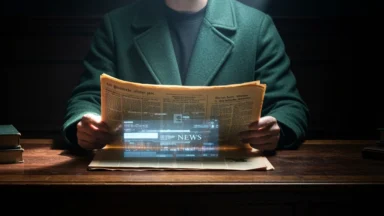
Navigating the daily news can often feel like trying to drink from a firehose. Every notification, feed refresh, and shared link contributes to a relentless flood of information, making it a genuine challenge to stay informed without feeling completely overwhelmed. A Pew Research Center report highlighted this, revealing that a staggering 68% of Americans feel worn out by the sheer volume of news available. This information overload isn’t just a minor inconvenience; it’s a significant barrier to understanding the world around us.
The problem extends beyond the quantity of content to its quality and intent. Misinformation, often engineered to provoke an emotional response rather than to inform, can spread far more rapidly than verified reports. This digital landscape requires a new set of skills. Without the ability to critically evaluate what we see, we risk falling into algorithm-driven echo chambers or developing a cynical distrust of all media, which is just as detrimental as believing everything we read. Learning to assess sources and identify bias is no longer a niche skill for academics; it’s a core requirement for modern citizenship.
So, how can you shift from being a passive recipient of information to an active, discerning consumer? This guide provides a practical toolkit for exactly that. We will explore how to decode a news source for credibility and bias, practice deep reading techniques to move beyond sensational headlines, and implement strategies to build a balanced and diverse news diet. These are the necessary skills for regaining control, making better-informed decisions, and navigating the complex media environment with confidence.
Why Critical News Consumption Matters in the Digital Age
Navigating the daily news can feel like trying to drink from a firehose. Every notification, feed refresh, and shared link adds to a relentless flood of information, making it difficult to keep up. This isn’t just a feeling; a Pew Research Center report revealed that a staggering 68% of Americans feel worn out by the sheer volume of news available. This information overload presents a significant challenge for anyone trying to stay informed.
The problem isn’t just the quantity of content, but its quality and intent. Misinformation can spread faster than verified reports, often designed to provoke an emotional response rather than to inform. But how do you separate the signal from the noise? Developing critical thinking skills is your primary defense, allowing you to question sources, identify bias, and understand the context behind a headline. It’s about shifting from being a passive recipient to an active participant in your own information diet.
This active engagement is more important than ever.
Without it, we risk falling into echo chambers or becoming cynical about all media, which is just as dangerous as believing everything you read. The data suggests—though not conclusively—that declining trust in institutions is partly linked to this overwhelming media environment. Learning to assess the reliability of news portals and actively seeking out unbiased news are no longer niche skills for journalists or academics; they are required for modern citizenship.
Ultimately, becoming a critical news consumer is about regaining control. It empowers you to understand the world more clearly, make better decisions, and engage in more meaningful conversations. It’s the difference between being carried away by the current and learning how to navigate the waters with purpose, using expert insights on current events to build a more complete picture (and let’s be honest, who has time to vet every single article?). The good news is that this is a learnable skill, and the first step is recognizing the need for it.
Decoding the Source: Identifying Credibility and Bias
Before you even read the headline, the most critical question is: who is telling me this story? Not all news sources are created equal, and understanding the origin of your information is the first line of defense against misinformation. It’s a foundational skill for navigating the modern media environment.
Thinking about a source’s credibility is like checking the foundation of a house before you buy it. A shaky foundation can make the entire structure untrustworthy, regardless of how nice it looks on the surface. A recent Gallup/Knight Foundation study found that 53% of Americans believe news organizations intend to mislead them. This widespread skepticism makes source evaluation more important than ever.
Recognizing Different Forms of Media Bias
Bias isn’t always a sinister plot to mislead you; sometimes it’s simply a byproduct of perspective or ownership. The most obvious is political bias, where an outlet consistently favors one political party or ideology, often shaping stories to fit a specific narrative. Beyond politics, lies corporate bias, where the business interests of a media company’s owner or advertisers can influence what stories get covered—or ignored. What most people miss is that bias can also manifest through omission. What isn’t being reported can be just as telling as what is. Is a major local story missing from a publication owned by the company involved?
This is where active reading comes in. Learning to spot these patterns is a key part of finding unbiased news. For a deeper look at this challenge, check out this guide to finding unbiased news sources.
To help, here are some common indicators:
- Credible Source Indicators:
- Clearly stated corrections policy and visible corrections on past articles.
- Named authors with verifiable credentials or reporting histories.
- Citations and links to original sources, data, and studies.
- A professional “About Us” page detailing funding and leadership.
- Neutral, fact-based language rather than emotionally charged words.
- Less Credible Source Indicators:
- No listed author or the use of vague pseudonyms.
- Frequent spelling and grammatical errors.
- Sensationalist headlines that rely on outrage or shock.
- No clear way to contact the organization or its editors.
- An overwhelming number of ads that interfere with the content.
Tools and Techniques for Quick Source Verification
You don’t need to be a private investigator to check a source. The process can be surprisingly quick. Start by simply cross-referencing the story. If a major event is being reported, are other reputable outlets also covering it? Getting information from a single source without confirmation is like taking medical advice from a stranger without getting a second opinion from a doctor. It’s a risk.
Take 30 seconds to investigate the outlet itself. Search for its name along with terms like “bias” or “reliability.” Professional fact-checking organizations like the Associated Press Fact Check or Reuters have likely already reviewed major news providers. This process provides key context about a news portal’s overall reliability. Understanding how news portals prioritize stories can also reveal their editorial leanings.
This habit of quick verification may feel slow at first. But with practice, it becomes a nearly unconscious and necessary part of responsibly consuming the news.
The greatest challenge to being informed today is not a lack of information, but the overwhelming volume of it. The public feels worn out, and that fatigue can lead to disengagement.
— Analysis based on findings from the Pew Research Center
| Essential Skill | Key Action |
|---|---|
| Source Vetting | Quickly verify the author, outlet reputation, and cross-reference the story with other established sources. |
| Deep Reading & Analysis | Move beyond the headline to understand the full context, questioning the who, what, why, and how of the story. |
| Bias & Fallacy Detection | Identify emotionally charged language, logical errors, and look for what information might be intentionally omitted. |
| Building a Balanced Diet | Actively seek out diverse perspectives, including international, local, and expert sources outside your usual bubble. |
| Responsible Fact-Checking | Use independent resources like the AP Fact Check or Reuters to verify specific claims before accepting or sharing them. |
Beyond the Headline: Practicing Deep Reading and Analysis
Skimming headlines gives you a snapshot, but it’s like only reading the name of a dish on a menu. You know it’s “Lemon Herb Chicken,” but you have no idea about the ingredients, the cooking process, or how it tastes. To understand the news, you need to practice deep reading, a method of engaging with the text to extract more than just the surface-level facts. This means slowing down and actively questioning the content in front of you.
The average person spends shockingly little time on a single news article. A study by the Chartbeat data analytics firm found that most readers only get about 15 seconds into a story before clicking away. This habit leaves us vulnerable to misinformation and incomplete narratives. Real comprehension requires a more deliberate approach.
Unpacking the Narrative: Who, What, When, Where, Why, How
Every news story is a constructed narrative. The classic “5 Ws and H” (Who, What, When, Where, Why, and How) are your basic tools for deconstruction. Going beyond just identifying these elements, you should question them. Who are the key players mentioned, and who is left out? What specific event is being reported, and what is being framed as the most important detail?
The “why” and “how” are often the most critical for deep understanding. These elements move beyond simple fact-reporting into the realm of analysis and interpretation. Surprisingly, what most people miss is that the ‘why’ is where a story’s underlying bias or perspective often reveals itself. Understanding how news portals prioritize stories can give you clues about the “why” they’ve chosen to highlight a particular angle.
Think of yourself as a detective. A good report provides clear answers, but a great reader asks follow-up questions. Why was this particular source quoted? How does this event connect to previous ones? This active questioning is the engine of critical analysis.
Identifying Logical Fallacies in News Reporting
News articles, especially opinion pieces and commentary, are not immune to flawed logic. Logical fallacies are errors in reasoning that undermine the validity of an argument, even if the conclusion seems plausible at first. Being able to spot them is a superpower for any news consumer.
Common fallacies you might encounter include:
- Ad Hominem: Attacking the person making an argument instead of the argument itself. (e.g., “You can’t trust his economic plan; he got a divorce last year.”)
- Straw Man: Misrepresenting someone’s argument to make it easier to attack. (e.g., “So you support clean energy? You must want to shut down all businesses and go back to the Stone Age.”)
- False Dichotomy: Presenting two options as the only possibilities, when in fact more exist. (e.g., “We must either raise taxes or slash public education funding.”)
But how often do we stop to check if the argument presented actually makes sense? Spotting these fallacies helps you separate a well-reasoned point from persuasive but empty rhetoric. It’s a key part of assessing the overall reliability of a news source and its commitment to factual integrity.
The Role of Context: Historical, Social, and Political
A news story rarely exists in a vacuum. It is a single frame in a much longer film, influenced by historical events, social dynamics, and the political climate. Without this context, information can be easily misinterpreted or its significance completely missed. A protest, for example, isn’t just a group of people shouting; it’s the result of specific grievances and historical precedents.
This is where consuming a variety of content becomes useful. Reading expert insights on current events or historical analyses provides the background knowledge needed to make sense of today’s headlines. It connects the dots between a current event and the long-term trends that led to it.
Why a Story’s Background is notable
Consider a report on a new trade agreement between two countries. Without historical context, it’s just a business deal. But with context, you might understand it as the resolution of a decades-long trade dispute, a strategic political alliance against a rival power, or a response to domestic economic pressures. Each context completely changes the story’s meaning — and its implications.
The background information is what gives a story its weight and significance. It’s the difference between knowing what happened and understanding why it matters. Lacking this context is like trying to solve a puzzle with half the pieces missing; you might see a partial image, but you’ll never grasp the full picture.

Building a Balanced News Diet: Strategies for Diverse Perspectives
Most of us don’t consciously choose our news diet. Algorithms often do it for us, serving a steady stream of content that confirms what we already believe, creating a comfortable but dangerously narrow “echo chamber.” This process is subtle and efficient. It’s like only eating your favorite dessert; it’s satisfying in the moment but lacks the required nutrients for a complete understanding of the world.
The data suggests—though not conclusively—that this effect is widespread. A Pew Research Center study found that people at both ends of the political spectrum are increasingly isolated in their media habits. For instance, 47% of those identifying as consistently conservative named a single news source as their main outlet, creating a significant information bubble that can warp perceptions of reality.
The result is a distorted worldview.
Escaping the Echo Chamber: Practical Steps
The solution isn’t about abandoning your trusted sources, but actively supplementing them. Purposefully adding a bit of friction to your information consumption forces more critical engagement with complex topics. How often do you intentionally read an opinion piece you know you’ll disagree with? Doing so is a workout for your critical thinking muscles.
Here is a simple checklist for building a more balanced feed:
- Diversify Politically: Intentionally follow at least two reputable sources from a different political viewpoint than your own. The goal isn’t conversion, but comprehension.
- Go Global: Add an international news source like Reuters, Associated Press, or the BBC to your daily reading. This provides a non-domestic perspective on major events that can reveal national biases.
- Think Local: Don’t forget local newspapers or community blogs. They often cover critical issues—like zoning laws or school board decisions—that national outlets miss entirely.
- Follow the Experts: Subscribe to newsletters from individual journalists or academics. Their deep dives provide the kind of nuance and expert insights on current events you won’t find in a 300-word breaking news alert.
The underrated factor here is that the objective isn’t to change your mind, but to understand precisely why others hold different views. This effort builds intellectual empathy and ultimately strengthens the foundation of your own arguments. It’s a key part of any guide to finding unbiased news in a complicated media environment.
Leveraging Aggregators and Curated Feeds Responsibly
News aggregators and curated feeds seem like a perfect solution, promising a wide array of stories in one convenient place. But their algorithms are designed for engagement, not necessarily for intellectual diversity. What most people miss is that these platforms learn your preferences with alarming speed, potentially building a new—and more refined—echo chamber just for you.
You have to actively manage these tools. Think of it like training a puppy; if you don’t set clear boundaries and provide consistent direction, you can’t be surprised when it only brings you the same worn-out toy. This means going into the settings and manually adding a wide spectrum of sources.
Don’t just live in the “For You” tab.
Actively explore general topic sections like “World,” “Technology,” or “Politics” to see what stories are trending outside your customized bubble. Many apps allow you to see different perspectives on the same story side-by-side, a feature that is surprisingly useful. The choice of navigating information through apps vs. feeds becomes less about the tool itself and more about the discipline you bring to using it.
Curation is not a one-time setup. It’s an ongoing practice of intellectual gardening, requiring you to constantly weed out creeping biases and plant seeds of new perspectives.
Cultivating Mindful News Consumption Habits
Once you’ve diversified your sources, the next hurdle is managing the sheer volume of information. Constant exposure to breaking news, especially negative events, can have a significant psychological toll. A study reported by the American Psychological Association found that for many people, persistent news monitoring leads to stress, anxiety, and a sense of powerlessness. This is often called news fatigue.
The key to avoiding this burnout is practicing mindful news consumption. This doesn’t mean becoming uninformed; it means being intentional. Think of it like managing your diet. You wouldn’t eat junk food all day, so why consume an endless stream of unfiltered, often distressing, information? The underrated factor here is creating structure where there is none.
Start by setting clear boundaries. Designate specific times for checking the news, perhaps 15 minutes in the morning and 15 in the evening. This simple act reclaims your attention and prevents the constant drip of notifications from dictating your mood. It also means establishing news-free zones and times—no doomscrolling at the dinner table or right before bed, a surprisingly difficult habit to break.
Another powerful strategy is shifting your focus toward solutions-oriented journalism. Instead of only reading about problems, actively seek out stories that explore responses and potential fixes. Pairing your daily briefing with deeper expert insights on current events provides context that a headline alone cannot. Ultimately, successfully navigating the information highway is less about how much you know and more about how you process it. This proactive approach turns passive anxiety into engaged awareness.
Beyond Consumption: Becoming a Conscious Information Citizen
Mastering the skills outlined here does more than just protect you from misinformation; it fundamentally changes your relationship with the news. Moving forward, the challenge isn’t simply to consume information more critically, but to use that well-curated understanding to engage more thoughtfully with the world. How might your conversations change if they were built on a foundation of diverse, well-vetted sources rather than a single, algorithm-fueled feed?
Ultimately, a well-informed individual is an empowered one. By consciously shaping our information diet, we not only improve our own understanding but also contribute to a healthier public discourse. Every time you question a source, resist sharing an unverified story, or seek out an opposing viewpoint, you cast a small vote for a more rational and nuanced information ecosystem. The real question then becomes: what will you do with your sharpened perception?
Frequently Asked Questions
How can I quickly check if a news source is reliable?
Check for a clearly stated corrections policy, named authors with credentials, and citations to original data. A quick search for the source’s name plus the word ‘bias’ can also reveal its reputation among media watchdog groups. Reliable sources aren’t afraid to show their work.
What’s the difference between objective reporting and opinion pieces?
Objective reporting focuses on presenting verifiable facts from multiple sources without emotional language or personal viewpoints. Opinion pieces, often labeled ‘Op-Ed’ or ‘Commentary,’ are designed to argue a specific point of view and use persuasive language to convince the reader.
How can I avoid getting overwhelmed by negative news?
Set specific, limited times to check the news each day rather than staying constantly connected. Actively seek out ‘solutions journalism’ or positive stories to balance your intake. Curating your news diet is key to staying informed without burning out.
Are social media news feeds ever reliable?
Social media feeds are not primary sources; they are algorithmic distributors of content designed for engagement, not accuracy. While they can link to reliable articles, they also amplify misinformation. Always click through to the original source and vet it independently.
What are some good resources for fact-checking news stories?
Several non-partisan organizations specialize in fact-checking. Excellent, widely respected resources include the Associated Press (AP) Fact Check, Reuters Fact Check, Snopes, and PolitiFact. They provide detailed analysis of claims made in the media and by public figures.