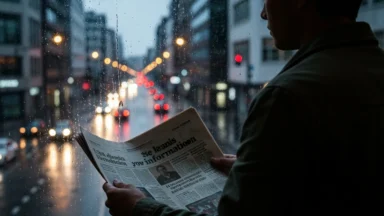
In an endless stream of updates, notifications, and breaking stories, how can you be sure what you’re reading is true? The line between credible journalism and refined fabrication has never been more blurred. We’re bombarded daily by headlines engineered to provoke outrage, fear, or validation, making it dangerously easy to accept and share information that aligns with our feelings rather than the facts. This isn’t just about spotting a few typos anymore; it’s about navigating a complex digital landscape designed to manipulate.
The challenge has evolved far beyond clumsy hoaxes. Today’s disinformation campaigns leverage AI-generated imagery, deepfake videos, and professionally designed websites that perfectly mimic legitimate news portals. These tactics are successful because they exploit our cognitive biases, preying on our natural tendency to believe what confirms our existing views. The result is an environment where falsehoods can travel faster and wider than the truth, creating digital echo chambers that reinforce division and distrust.
This guide is your necessary toolkit for fighting back. We will move beyond the basics and equip you with practical strategies to become a more discerning news consumer. You’ll learn how to identify the subtle red flags in headlines and URLs, master the tools professionals use for fact-checking, and understand the psychological triggers that make us vulnerable to misinformation. By the end, you’ll not only be able to protect yourself but also play a key role in promoting a healthier information ecosystem for everyone.
The Evolving Landscape of Digital Disinformation
Digital disinformation isn’t a new problem, but its scale and speed certainly are. Decades ago, a false story took time and effort to spread, but today’s online portals can amplify a single fabricated headline across the globe in a matter of minutes. The sheer volume makes it difficult for even the most discerning readers to separate fact from fiction. According to a recent MIT Technology Review report, automated bots are responsible for amplifying false narratives by as much as 73% during major news events, muddying the waters for anyone seeking clear analysis of current events.
This creates a constant state of information overload. Trying to keep up is like trying to get a sip of water from a firehose — you’re drenched with an endless stream of content, but it’s nearly impossible to consume what you actually need. Sorting through the constant updates is a significant challenge when you’re just trying to stay informed on daily headlines.
The tactics have also become much more technical.
Early fake news was often riddled with obvious typos and clumsy formatting. Now, malicious actors use AI-generated images, deepfake videos, and professionally designed websites that mimic legitimate news sources almost perfectly. The underrated factor is how these fakes prey on our emotions, using outrage and fear to bypass critical thinking. So what’s the real test of a news portal’s reliability when the forgeries look so convincing? This new reality demands a new set of skills for every news consumer.
Red Flags: Key Indicators of Unreliable News Sources
Spotting fake news is a lot like checking if a piece of fruit is ripe; you have to know what signs to look for. Disinformation often hides in plain sight, disguised as legitimate journalism. The first line of defense is developing a healthy skepticism and training your eye to catch the subtle (and sometimes not-so-subtle) clues that something is amiss. These indicators won’t always mean a story is false, but they should prompt you to slow down and investigate further.
Think of it as a quick mental checklist before you accept information as fact.
Analyzing Headline and URL Anomalies
Sensational headlines are a classic giveaway. If an article’s title is filled with excessive punctuation, ALL CAPS, or makes an outrageous claim designed to provoke a strong emotional reaction, proceed with caution. A 2018 study by researchers at MIT found that false news diffused “farther, faster, deeper, and more broadly” than the truth, largely because it was often more novel and surprising. These headlines are engineered for clicks, not clarity. They prey on our instincts to share what shocks us.
Beyond the headline, the website’s URL itself can reveal a lot. Look for slight misspellings of well-known news outlets, like “cbs-news.com.co” instead of “cbsnews.com.” These imposter sites are designed to mimic trusted sources. Also, pay attention to the domain extension. While many legitimate sites use extensions like .biz or .info, they are also frequently used by low-quality sources. Understanding how news portals prioritize and present stories legitimately can help you spot these fakes more easily.
Evaluating Author Credibility and Source Bias
A credible news article should have a clear author. If an article has no byline, or the author is listed as “Admin” or a generic pseudonym, that’s a major red flag. Do a quick search on the author’s name. Do they have a professional history in journalism? What else have they written? A complete lack of a digital footprint is suspicious for anyone claiming to be a reporter.
Similarly, every reputable news organization will have an easily accessible “About Us” or “Contact” page that outlines its mission and editorial standards. The absence of this information suggests a lack of transparency. The data suggests—though not conclusively—that sites without clear mission statements have a higher probability of publishing biased content. What most people miss is that this evaluation is a key step in finding sources that offer unbiased news.
To put it simply, here are some key indicators of a questionable source:
- The headline is shocking and uses excessive capitalization or punctuation.
- The URL is a close imitation of a known, reputable source.
- There is no author listed, or the author has no verifiable credentials.
- The article lacks sources, citations, or links to primary information.
- The site has no “About Us” page or contact information. This directly impacts overall long-term news portal reliability.
- The only sources cited are other anonymous blogs or outlets with the same bias.
Recognizing these signs is the first step, but the next challenge involves actively verifying the claims made even in articles that seem legitimate at first glance.
When we encounter information that elicits a powerful feeling, the brain’s limbic system takes over, prioritizing a rapid response over the slower, more deliberate process of verification.
— Dr. Lena Petrova, behavioral psychologist
| Red Flag Category | Specific Signs to Watch For |
|---|---|
| Headline & URL | Uses ALL CAPS, excessive punctuation, or emotionally charged language. URL mimics a known site but has slight misspellings or an unusual domain extension (.com.co, .biz). |
| Author & Sourcing | No author is listed, the byline is generic (e.g., ‘Admin’), or the author has no verifiable journalistic history. The article lacks links to primary sources or only cites other biased outlets. |
| Website Transparency | The site is missing a clear ‘About Us’ page, editorial standards, or contact information. This suggests a lack of accountability. |
| Emotional Response | The content makes you feel immediate, intense anger or outrage. This is often a deliberate tactic to bypass your critical thinking. |
Tools and Techniques for Fact-Checking Like a Pro
Moving beyond gut feelings and red flags requires a more active approach. You don’t need to be an investigative journalist to verify information effectively. With the right digital tools and a methodical mindset, you can build a reliable verification process to sort fact from fiction. It’s less about having secret knowledge and more about knowing where to look.
Think of it as assembling a toolkit. Each tool has a specific purpose, from checking a suspicious image to confirming a surprising claim. Learning to use them turns you from a passive news consumer into an empowered, critical reader.
Leveraging Dedicated Fact-Checking Platforms
Your first line of defense should be the professionals who do this for a living. Independent, non-partisan organizations like Snopes, PolitiFact, and FactCheck.org dedicate their resources to investigating viral claims, political statements, and media reports. These sites provide detailed breakdowns of their research, showing you exactly how they arrived at their conclusions.
They don’t just label something “true” or “false.” They often provide extensive context that helps you understand the nuances of a story. According to the Poynter Institute, which runs PolitiFact, their fact-checkers contact sources, review original documents, and consult multiple experts before publishing a rating. This rigorous process is something individuals can learn from when assessing news portal reliability.
These platforms are especially useful for debunking widely circulated hoaxes that are designed to go viral.
The Power of Reverse Image and Video Search
Misleading images and videos are a cornerstone of modern disinformation. A photo from one event can be repurposed years later with a completely new, false context to stir outrage. The good news is that you can often uncover the original source in seconds using a reverse image search.
Services like Google Images and TinEye allow you to upload a photo or paste an image URL to see where else it has appeared online. This process — a surprisingly simple trick that works wonders — can instantly reveal if a photo of a “recent” protest is actually from a different country five years ago. For video, tools from organizations like Amnesty International can help capture thumbnails for a similar reverse search, helping you trace a clip’s digital footprint.
Cross-Referencing: A Multi-Source Approach
A single source is never enough, especially for a contentious or surprising story. The key is to practice what journalists call “lateral reading.” Instead of staying on one page to analyze it, you immediately open new tabs to see what other sources are saying about the same topic. The goal isn’t just to find more articles; it’s to find better ones.
Did a major, reputable news organization like Reuters, the Associated Press, or the BBC also report the story? If a shocking claim only appears on a handful of unknown blogs, that’s a massive red flag. This method forces you to step outside a potential echo chamber and evaluate the broader consensus, which is a core skill for finding unbiased news from various outlets.
Identifying Primary vs. Secondary Sources
While cross-referencing, it’s helpful to understand the difference between source types. A primary source is the raw material of a story: an original study, a government report, a direct quote from an eyewitness, or raw video footage. A secondary source is an article or report that analyzes, interprets, or summarizes that primary information.
What most people miss is that many news articles are secondary sources. A good reporter will link to or clearly cite their primary sources. If you can, always try to get back to the original document. Did a news article accurately summarize the findings of that scientific study? Reading the study’s abstract yourself can often provide a much clearer picture than someone else’s interpretation or expert analysis of events.
This simple act of going one level deeper cuts through a huge amount of potential misinterpretation and spin. It puts you in control of the information, rather than relying solely on the narrator.

Understanding the Psychology Behind Fake News
Knowing how to use fact-checking tools is only half the battle. The other half involves understanding our own minds, which are surprisingly susceptible to misinformation. The most convincing falsehoods don’t just target our logic; they exploit our ingrained psychological tendencies. It’s an uncomfortable truth.
These stories are crafted to bypass critical thinking and appeal directly to our instincts. What makes a piece of information feel true, even when it isn’t? The answer lies in cognitive biases that operate just below the surface of our conscious thought.
The Lure of Sensationalism and Emotional Triggers
Fake news often works because it triggers a strong emotional response. Content that makes us angry, fearful, or overjoyed is more likely to be shared without scrutiny. A study from researchers at MIT found that false news on social media spread significantly farther, faster, and more broadly than the truth, often because it was more novel and surprising.
This happens because strong emotions can temporarily short-circuit our analytical reasoning. Dr. Lena Petrova, a behavioral psychologist and author, explains that our brains are wired for efficiency. “When we encounter information that elicits a powerful feeling, the brain’s limbic system takes over, prioritizing a rapid response over the slower, more deliberate process of verification,” she notes. Think of it like a smoke alarm—it’s designed to react instantly to a potential threat, even if it sometimes gets triggered by burnt toast.
Confirmation Bias and Digital Echo Chambers
One of the most powerful psychological effects at play is confirmation bias. This is our natural tendency to search for, interpret, and recall information in a way that confirms our preexisting beliefs. Fake news creators are experts at exploiting this. They package their narratives to perfectly align with the views of a specific audience, making the content feel intuitively correct.
This problem is magnified by digital echo chambers. Social media and news aggregator algorithms learn what you like and show you more of the same. Over time, your feed becomes a curated reality that reinforces your biases, starving you of opposing viewpoints. You might think you’re getting a full picture of the day’s events, but what you’re often seeing is a reflection of your own opinions. The best way to combat this is to actively search for unbiased news sources that challenge your perspective.
This creates a feedback loop. The more we see information that confirms our views—real or fake—the more convinced we become of our own correctness. Breaking this cycle requires a conscious effort to engage with different ideas and explore expert insights that may offer a new angle on a familiar topic.
Your Role in Combating Misinformation: A Responsible Approach
The power to stop fake news doesn’t rest solely with tech giants or government bodies; a significant part of that responsibility lands squarely on our own shoulders. Every time we share an article or forward a message, we become a publisher. This shift makes digital citizenship more than just a buzzword—it’s an active practice of responsibility. The previous section highlighted how our own biases can make us vulnerable, but understanding that is the first step toward building a defense.
Think of it like this: sharing an unverified story is the digital equivalent of hearing a rumor at the grocery store and immediately shouting it in the town square. The damage is done before the truth can even put its shoes on. We have to be the gatekeepers of our own social feeds.
Before You Share: A Quick Verification Protocol
Before an article makes it to your timeline, it should pass a basic inspection. This isn’t about becoming a full-time private investigator; it’s about developing a healthy skepticism and a simple, repeatable habit. What most people miss is that a 30-second check can prevent the spread of a falsehood that takes days to debunk. But how often do we actually stop to think before hitting that share button?
A good protocol involves a few key actions. First, pause and check your emotional response. Does the headline make you immediately angry or overjoyed? Strong emotional reactions are a tool often used to bypass critical thinking. Next, cross-reference the story with a couple of other known sources, which is a core tenet of finding unbiased news sources. If a major event is being reported, outlets like Reuters, the Associated Press, or the BBC will almost certainly have it.
Here’s a quick guide to responsible sharing:
| What to Do | What to Avoid |
|---|---|
| Pause and Reflect: Check your emotional reaction before sharing. | Sharing Instantly: Never share based on the headline alone. |
| Check the Source: Is it a reputable outlet? Look into its “About Us” page. | Trusting Unfamiliar URLs: Be wary of sites with strange domain names (e.g., .co, .biz). |
| Look for Evidence: Does the article cite sources, data, or experts? | Accepting Screenshots as Proof: Images and text can be easily manipulated. |
| Perform a Quick Search: See if other credible news outlets are reporting the same story. | Ignoring Fact-Checkers: Disregarding warnings from platforms or known fact-checking sites. |
Reporting Misinformation: Empowering Digital Platforms
Actively reporting fake news is a powerful tool at your disposal. Social media and search platforms rely on user signals to identify problematic content. While their algorithms are constantly working, they aren’t perfect. Your report acts as a key data point that helps platforms identify and limit the reach of harmful narratives.
Surprisingly, many users don’t take this step. A study from the University of Oxford’s Reuters Institute found that while over 60% of people are concerned about misinformation, fewer than 25% have ever reported a false story to a platform. It’s a simple action—usually just a few clicks—that contributes to a healthier information environment for everyone. Think of it as a community watch program for the internet.
Fostering Media Literacy in Your Community
Combating misinformation extends beyond your own screen. Promoting media literacy within your family, friend groups, and local community can create a ripple effect. This doesn’t have to be a formal lecture; it can be as simple as gently questioning a shared story in a family group chat or sharing resources on how to spot fake news. The goal is to encourage critical thinking, not to start arguments.
By helping others understand the tactics used in disinformation campaigns, you empower them to become more discerning consumers of information. This includes discussing the importance of understanding the reliability of news portals and seeking out diverse perspectives. It’s about teaching people how to fish for the truth, rather than just giving them a fact-checked fish.
Educating Younger Generations
For younger people who have grown up in a world saturated with digital content, media literacy is a underlying life skill. Parents and educators have a vital role in teaching them to question what they see online. This involves explaining that not everything presented as news is accurate and showing them how to perform basic checks—like reverse image searching to find a photo’s origin or looking up an author’s credentials.
Initiatives like Common Sense Media provide resources specifically designed for this purpose. The aim is to instill a habit of critical consumption from an early age (and let’s be honest, many adults could use a refresher too). The habits we build today don’t just protect our own timelines; they create a more informed digital ecosystem for everyone who follows.
The Next Frontier: Your Role in the Age of AI Disinformation
As we look ahead, the challenge of identifying fake news is set to become even more complex with the rapid advancement of generative AI. The tools that create convincing deepfakes and fabricate entire articles will only become more accessible and technical. This reality doesn’t call for despair, but for a core shift in how we value information. Will we prioritize the speed of a share over the certainty of the truth? The answer to that question, repeated across millions of individual choices daily, will shape our collective future. Your critical thinking is no longer just a personal skill—it’s a vital defense for a civil society.
Frequently Asked Questions
What is the primary difference between misinformation and disinformation?
The key difference is intent. Misinformation is false information that is spread regardless of intent, often by people who believe it to be true. Disinformation, is deliberately created and shared with the specific intention to deceive, mislead, or cause harm.
Can AI-generated content be considered fake news?
Absolutely. AI can be used to create highly realistic but entirely fabricated text, images, and videos, which are powerful tools for disinformation. While AI can also be used for legitimate purposes, content generated to deliberately mislead people falls squarely under the umbrella of fake news.
How do I know if a fact-checking website is reliable?
A reliable fact-checking site is transparent about its methodology, funding, and staff. Look for organizations that are non-partisan signatories of the International Fact-Checking Network’s (IFCN) code of principles. They should provide clear links to their sources so you can verify their work.
What are the long-term impacts of widespread fake news on society?
Widespread fake news erodes trust in institutions like the media, government, and science. It can deepen social and political divisions, incite violence, and undermine democratic processes by preventing citizens from making informed decisions based on a shared set of facts.
Should I confront friends or family who share fake news?
Confronting people directly can sometimes backfire, making them defensive. A better approach is often to engage privately and gently. You can share a link from a reliable fact-checking site and say something like, ‘I saw this article that offers a different perspective, thought you might find it interesting.’