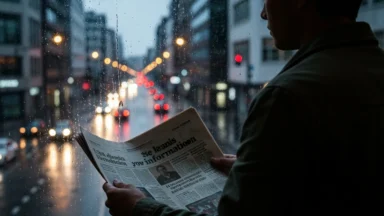
The daily ritual of unfolding a newspaper or waiting for the evening broadcast feels like a relic from a distant past. Today, we don’t seek out the news; it finds us. It arrives in a relentless stream of push notifications, algorithmically-curated feeds, and viral clips, creating a sense of information overload that is both empowering and exhausting. This constant barrage has fundamentally rewired not just how we consume information, but how we perceive the world around us. Are we more informed than ever, or simply caught in a more refined echo chamber?
This transformation didn’t happen overnight. It represents the latest chapter in a long history of media disruption, from the invention of the printing press to the dawn of radio and television. Each technological leap accelerated the speed and reach of information, but the internet’s arrival was different. It didn’t just introduce a new channel; it dismantled the entire top-down structure of news distribution, shifting power from a handful of established gatekeepers to vast technology platforms and, ostensibly, to the individual consumer.
This article unpacks the evolution of news in the digital age, charting the course from print to pixels. We will explore how social media and mobile technology have become the dominant forces in news consumption, creating both historic access and significant challenges like the fight against misinformation. we’ll look ahead at the emerging technologies like artificial intelligence and immersive reality that are already shaping the next frontier of journalism, before offering a guide for navigating this complex new landscape as a discerning reader.
From Print to Pixels: A Brief History of News Delivery
The concept of news is as old as human society, starting with town criers and oral traditions. For centuries, information moved at the speed of a person or a horse. The invention of the printing press by Johannes Gutenberg around 1440 was the first major disruption, allowing for the mass production of texts. This was less a sudden explosion and more of a slow burn; according to research from Oxford University, it still took over two centuries for newspapers to become a common fixture in major European cities. The pace of change accelerated dramatically with the advent of broadcast media. Radio brought live events and expert voices directly into living rooms, while television added a powerful visual layer that fundamentally altered politics and culture. What many people forget is the sheer dominance of these platforms; by the mid-1960s, a Nielsen report indicates that over 92% of American households owned a television set. News became a shared, scheduled experience. It was something you waited for. Then came the internet, which didn’t just accelerate delivery—it completely shattered the old model. The shift from a few authoritative sources to countless digital outlets created a new battleground for attention, demanding a complete rethink of SEO and content strategy for legacy publishers. The era of scheduled news ended, replaced by a 24/7 cycle where algorithms often play a key role in how news portals present stories to users. This digital leap set the stage for a far more complex and participatory information ecosystem.
The Digital Revolution: How Technology Redefined News Consumption
The constant stream of information didn’t just speed up the news; it fundamentally changed how we find and interact with it. The curated experience of a morning paper or an evening broadcast has been replaced by a personalized, and often chaotic, digital feed. This shift handed significant power from traditional publishers to technology platforms and individual consumers.
What most people miss is how this transition altered the very texture of news. Stories became atomized—disconnected from a larger publication and shared as individual links, snippets, or videos. This unbundling made content more shareable but also easier to consume out of context, creating new challenges for media literacy.
The Rise of Social Platforms as News Gatekeepers
Social media feeds have become the new front page for a significant portion of the population. According to the Pew Research Center, over half of U.S. adults get news from social media at least sometimes, turning platforms like Facebook, X, and even TikTok into de facto editors. The algorithm, not a human journalist, often decides what you see. It’s like going to a buffet where the chef keeps putting the same three dishes on your plate because you picked them once.
This creates an environment driven by engagement metrics—likes, shares, and comments. But what does this mean for the quality of information? A story’s virality can easily overshadow its accuracy, putting the onus on the reader to develop smarter habits for staying informed. The entire system has forced news organizations to rethink how they prioritize and present stories to compete for fleeting attention.
Mobile-First: The Dominance of On-the-Go Information
The smartphone is arguably the single most disruptive force in modern journalism. It’s a newsstand, a television, and a printing press all in one device that fits in your pocket. A report from the Reuters Institute noted that in many countries, over 70% of people access news weekly via their smartphones. This is a staggering statistic.
This mobile dominance has led to the rise of mobile journalism, where content is specifically designed for small screens and short attention spans. Think push notifications for breaking alerts, vertical video, and concise articles that can be scanned while waiting in line for coffee. This shift from desktop to pocket has completely altered the decision-making process for consumers choosing between dedicated news apps versus social media feeds for their daily updates.
The result is a more immediate but also more fragmented news experience. Publishers must now master not just storytelling but also the technical aspects of reaching audiences on these devices, making things like a solid digital strategy for news portals more important than ever. The challenge now is how to convey complex issues with depth and nuance when the delivery mechanism favors speed and brevity.
The digital imperative is ‘publish first, verify later,’ which is the exact opposite of traditional journalistic practice. This inversion is responsible for a significant portion of the public’s trust deficit.
— Dr. Anya Sharma, Media Ethicist, Poynter Institute
| Era | Key Characteristics |
|---|---|
| Print Age (c. 1440–1920s) | Mass production via printing press; slow distribution; centralized, authoritative sources (newspapers); news as a physical object. |
| Broadcast Age (c. 1920s–1990s) | Radio and television deliver news directly into homes; introduction of audio and visuals; scheduled, shared experience (evening news). |
| Early Internet (c. 1990s–2000s) | Digital versions of print media; rise of news websites and blogs; 24/7 news cycle begins; information is ‘pulled’ by users. |
| Social & Mobile Age (Present) | Dominance of smartphones and social media platforms; algorithmic curation; news is atomized and ‘pushed’ to users; rise of misinformation. |
Challenges and Opportunities: Navigating the Modern News Landscape
The digital transformation of news is a complex story of both peril and promise. While technology has democratized information access on a global scale, it has also introduced significant hurdles that challenge the very foundation of journalism. For every opportunity to engage with audiences in new ways, a corresponding risk seems to emerge, creating a difficult environment for publishers and consumers alike. The path forward requires a clear-eyed view of these intertwined realities.
The Battle Against Misinformation and ‘Fake News’
One of the most pressing challenges is the rampant spread of misinformation. The same social media platforms that deliver breaking news can also act as powerful amplifiers for falsehoods, which are often designed to be more emotionally engaging than factual reporting. According to a recent report from the Reuters Institute, nearly 56% of people express concern about their ability to distinguish real news from fabricated stories online. This creates a polluted information ecosystem. Journalists are no longer just reporting the news; they are actively competing against viral narratives that require little to no factual basis.
The underrated factor here is the speed at which this happens. A false story can circle the globe before a single fact-checker has finished their morning coffee. So, how can news organizations effectively combat this tide? Many are now investing heavily in dedicated fact-checking teams and promoting media literacy initiatives to help audiences develop critical consumption habits. Understanding the markers of news portal reliability has become a key skill for every citizen.
Ethical Dilemmas in a Fast-Paced Digital World
The demand for instant updates has placed immense pressure on journalists, creating a breeding ground for ethical missteps. The 24/7 news cycle often prioritizes speed over accuracy, leading to premature reporting and corrections that get far less attention than the original error. This process is like trying to assemble a complex piece of machinery while it’s already running at full speed — mistakes are almost inevitable.
This creates a constant ethical tightrope walk. Reporters must balance the public’s right to know with the professional duty to verify information rigorously. Dr. Anya Sharma, a media ethicist at the Poynter Institute, explains, “The digital imperative is ‘publish first, verify later,’ which is the exact opposite of traditional journalistic practice. This inversion is responsible for a significant portion of the public’s trust deficit.” These decisions directly influence how news outlets prioritize and present stories to their audience, often with major consequences.
Reinventing Revenue: Subscriptions, Ads, and Beyond
For decades, advertising revenue comfortably supported most news operations. That model is broken.
The shift to digital platforms decimated classified and print ad income, forcing publications to find new ways to stay afloat. Today, the most common revenue models include digital subscriptions with paywalls, programmatic advertising, and membership or donation programs. Major outlets like The New York Times have found success with subscriptions, but this approach is much harder for smaller, local newsrooms that can’t command the same loyalty. Programmatic ads, meanwhile, often yield pennies on the dollar and are subject to the whims of ad-blockers — which are now used by over 42% of internet users globally, according to Hootsuite data.
This has led to a period of intense experimentation. Publishers are exploring everything from sponsored content and newsletters to live events and micropayments. There is no single magic bullet, and what works for one organization might fail for another (a frustrating reality for publishers just trying to keep the lights on).
The Pros and Cons of Digital Journalism
The digital era presents a clear set of trade-offs that define the modern state of news. Understanding these dualities is key to appreciating the current landscape and the future of information.
- Pros: Immediate global reach, the ability to embed interactive content like data visualizations and videos, direct audience feedback through comments and social media, and a lower barrier to entry for diverse voices to launch new publications and find an audience through smart strategy.
- Cons: Pervasive information overload, the creation of echo chambers that reinforce bias, economic pressures that incentivize clickbait over quality, and a significant erosion of public trust due to polarization and the prevalence of misinformation.
Ultimately, the digital environment has unlocked incredible tools for reporting and connection, but it also demands a higher level of vigilance and critical thinking from both producers and consumers of news.

Emerging Technologies Shaping Tomorrow’s News
While the news industry grapples with today’s challenges, a new set of tools is already defining the future. Technologies once confined to science fiction are now entering the newsroom, promising to change how stories are created, distributed, and experienced. The focus is shifting from simply reporting the news to creating more personalized and immersive ways for audiences to engage with it.
Artificial Intelligence: Automation and Personalization
Artificial Intelligence is arguably the most impactful technology currently reshaping journalism. Many outlets already use AI in journalism to automate routine tasks, such as writing corporate earnings reports or local sports summaries. For instance, The Associated Press generates thousands of such articles using AI, which frees up human reporters to pursue more complex, investigative stories. This isn’t about replacement; it’s about reallocation of precious human resources.
Beyond automation, AI is the engine behind the personalized news feeds we scroll through daily. Algorithms analyze your reading habits to determine how news portals prioritize stories specifically for you. The data suggests this is getting much more refined. According to Dr. Evelyn Reed, a media-tech analyst at the Reuters Institute, “AI’s role is to augment journalists, not replace them. It handles the data-heavy lifting, allowing humans to focus on the nuance and the narrative.”
This changes everything.
Still, this level of personalization presents a risk. It can create a “filter bubble,” where you are only exposed to content that confirms your existing beliefs. The underrated factor here is that a curated feed, if not balanced, is like a diet based solely on what a restaurant app recommends from your last order; you might enjoy it, but you’ll miss a whole world of different flavors.
Immersive Storytelling with VR and AR
Some technologies aim to put the audience directly inside the story. Virtual Reality (VR) and Augmented Reality (AR) are moving from niche gaming applications to serious journalistic tools. Outlets like The New York Times have experimented with VR/AR news for years, producing experiences that transport viewers to distant places, such as inside a refugee camp or to the surface of Mars. The goal is to build empathy in a way text and video cannot.
What if you could understand the scale of deforestation by virtually standing in a cleared section of the Amazon rainforest? That’s the potential. Wide adoption, faces hurdles. A report from the Pew Research Center found that while awareness is high, only about 23% of U.S. adults have actually used a VR headset, citing cost and complexity as primary barriers.
Augmented Reality, which overlays digital information onto the real world via a smartphone, is more accessible. News organizations are using AR to bring 3D models of everything from election data to complex scientific concepts into a reader’s living room. This creates a more interactive and memorable way to present information — a far cry from the flat newspaper graphics of the past — and is a key part of any modern content strategy for engaging audiences.
Finally, there’s the emerging role of blockchain news technology. Its primary appeal for journalism lies in its potential to combat misinformation. By creating a transparent and unchangeable ledger, blockchain can verify the origin and history of a photograph, video, or document, directly addressing the industry’s trust deficit. This quest for provable news portal reliability is becoming a central theme. These tools are not just novelties; they signal a underlying shift in how news is made and consumed.
The Future of News: A Reader’s Guide to Staying Informed
Navigating the modern information stream can feel like trying to take a sip from a fire hydrant. With endless updates, notifications, and competing headlines, simply staying informed is a challenge. The key isn’t to consume everything, but to consume wisely. It requires a new set of skills and a proactive mindset.
What most people miss is that becoming a savvy news consumer is an active process, not a passive one. It’s less about finding the “perfect” source and more about building a healthy, diversified information diet. This shift empowers you to distinguish credible reporting from the noise that clutters your feed.
Developing Media Literacy in a Complex World
Media literacy is your toolkit for the digital age. It’s the ability to access, analyze, evaluate, and create communication in a variety of forms. Without it, you’re susceptible to misinformation and manipulation. A recent study from the Stanford History Education Group found that an alarming 82% of middle-schoolers couldn’t distinguish between a real news story and a sponsored content piece. The problem isn’t just for kids.
Developing these skills means consistently asking questions as you read. Who created this message, and what is their purpose? What techniques are they using to get my attention? How might different people interpret this message differently? Building these reflexes is the first step toward developing smart habits for consuming news and becoming a more conscious reader. It’s about shifting from automatic acceptance to active questioning.
A Checklist for Evaluating News Sources
When you encounter a new source or a surprising story, run it through a quick mental checklist. Think of it as the nutritional label for your information. Consistent evaluation helps in gauging a news portal’s reliability over time.
- Check for a Byline: Is there a real author attached to the article? A lack of a named author can be a red flag, suggesting a lack of accountability for the content.
- Scan for Sources: Does the article cite its sources? Credible journalism links to original studies, quotes experts by name, or references official documents. Be wary of vague phrases like “experts say” or “a study found” without specifics.
- Investigate the “About Us” Page: A legitimate news organization will have a clear and accessible “About Us” or “Contact Us” section detailing its mission, funding, and leadership. If it’s hard to find out who is behind the site, proceed with caution.
- Look for Bias: Pay attention to the language. Is it loaded, emotional, or sensational? Does the headline match the content of the article? Good reporting presents facts neutrally, even when covering contentious topics.
- Verify with Other Sources: Before you share a shocking headline, can you find the same story reported by two or three other reputable, independent news outlets? This is perhaps the most powerful and simple step — it’s a process journalists call triangulation.
The Role of Citizen Journalism
The rise of smartphones and social media has empowered everyday people to report on events as they happen. This phenomenon, known as citizen journalism, offers incredible benefits, providing raw, on-the-ground footage and perspectives often missed by traditional media. It can bring immediate attention to local issues or global human rights abuses. It’s a powerful tool for transparency.
This raw feed comes with significant risks. Citizen reports often lack the rigorous fact-checking, context, and editorial oversight of professional newsrooms. A video clip can be powerful, but what happened just before or after it was filmed? What is the background of the person filming? Understanding how news portals prioritize stories helps explain why they may be slow to pick up a viral clip — they are often busy verifying it first.
The responsibility, ultimately, falls back on you, the reader. Treat citizen reports as valuable but unverified tips. Use them as a starting point for your own inquiry, not as a final conclusion. The future of news is not just about what journalists, AI, or citizen reporters produce; it’s about what you choose to believe and share.
Beyond Consumption: Our Role in the New Information Ecosystem
The evolution of news is no longer a passive story we observe; it’s an interactive reality we all shape with every click, share, and subscription. As technology continues to offer more personalized and immersive ways to experience world events, the tools of journalism are becoming more powerful. Yet, this raises a critical question: does a future where news is perfectly tailored to our individual preferences risk eroding the shared public square necessary for a functioning society? The ultimate responsibility may be shifting from the creators to the consumers. Perhaps the future of being well-informed depends less on which outlet we trust, and more on our collective willingness to build the critical thinking habits required to engage with a world of infinite information.
Frequently Asked Questions
How has social media changed news consumption habits?
Social media has shifted news consumption from a scheduled activity (like the evening news) to a constant, algorithmically-curated stream. It prioritizes engagement, which can amplify emotionally charged or sensational content over factual reporting, and has created ‘filter bubbles’ that may limit exposure to diverse viewpoints.
What are the biggest challenges facing traditional news organizations today?
The primary challenges include the collapse of traditional advertising revenue models, a significant erosion of public trust due to widespread misinformation, and intense competition for audience attention against social media platforms and content creators who are not bound by journalistic standards.
Will AI replace human journalists in the future?
It’s unlikely that AI will completely replace human journalists. Instead, it is being adopted as a tool to augment their work. AI excels at automating routine tasks like writing earnings reports and analyzing large datasets, which frees up human reporters to focus on in-depth investigation, interviews, and nuanced storytelling.
How can I identify reliable news sources online?
Look for sources with clear authorship, a public corrections policy, and citations for their data. Reliable journalism typically presents multiple viewpoints and distinguishes clearly between factual reporting and opinion pieces. Cross-referencing information with several different reputable sources is also a key practice.
What is ‘immersive journalism’?
Immersive journalism uses technologies like Virtual Reality (VR) and Augmented Reality (AR) to place the audience directly inside a story. The goal is to move beyond telling and showing, allowing the viewer to experience a location or event to foster a deeper sense of empathy and understanding that text or video alone cannot achieve.