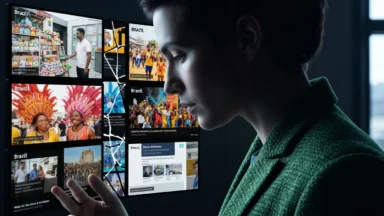
Trying to make sense of the news in Brazil can often feel like navigating a minefield. One headline screams about an impending economic crisis, while another, published the same day, paints a picture of strong growth. In family WhatsApp groups, viral videos and urgent-sounding audio clips spread like wildfire, often stripped of their original context and loaded with emotional baggage. This constant barrage of conflicting information leaves many feeling overwhelmed and unsure of what, or who, to believe.
This chaotic information landscape is no accident. It is the direct result of a complex interplay between historically concentrated media ownership, deep-seated political polarization, and the lightning-fast distribution channels of social media. For decades, a few powerful entities shaped the national narrative. Today, while new digital voices have emerged, the arena is more crowded and noisier than ever, with algorithms often rewarding outrage and sensationalism over accuracy and nuance. This environment creates fertile ground for misinformation to flourish, making critical thinking not just a helpful skill, but an required one.
So, how can you become a more discerning news consumer? This guide is designed to equip you with the practical tools and mental frameworks needed to cut through the noise. We will break down the most common misinformation tactics you’ll encounter, from subtle clickbait to deceptive out-of-context reporting. we’ll explore how to identify underlying political and economic biases that shape news coverage and provide a concrete checklist for verifying stories before you trust or share them. The goal is to move from being a passive recipient of information to an active, informed participant in it.
The Dynamic Landscape of Brazilian News Media
Trying to understand the news in Brazil can feel like trying to follow a dozen different conversations at a massive, loud family party. You have established legacy media groups, explosive digital-native outlets, and a constant hum of social media chatter all competing for your attention. It’s a lot to take in. This environment is both energetic and deeply polarized, which explains why a recent Reuters Institute Digital News Report found that overall trust in the news hovers around a modest 43%.
This complexity isn’t new. For decades, a handful of powerful families controlled the majority of newspapers, radio stations, and television networks. What most people miss is how this history of concentrated ownership directly shapes today’s headlines and influences how news portals prioritize stories. While the internet has opened the door for new voices, the old guard still holds significant sway over the national conversation.
So, who are the main players in this crowded room? You have giants like Grupo Globo, a massive conglomerate with a presence in nearly every form of media, alongside other major broadcasters such as RecordTV and Bandeirantes. At the same time, a growing number of independent online portals and investigative journalism collectives have emerged — sometimes offering a critical counter-narrative. This constant push and pull makes assessing news portal reliability a daily challenge for consumers.
This blend of old and new media creates a landscape where the same event can be framed in dramatically different ways depending on the source. For anyone trying to stay informed, navigating this requires more than just casual reading; it demands a conscious effort. Finding a neutral viewpoint is often the goal, making a guide to finding unbiased news an necessary tool for the modern Brazilian news consumer.
Recognizing Common Misinformation Tactics in Brazilian Reporting
To effectively navigate the Brazilian news environment, you must first learn to spot the common traps. These tactics aren’t always outright lies; often, they are subtle manipulations of the truth designed to provoke a specific reaction. Think of it less like a blatant forgery and more like a funhouse mirror—the reflection is based on reality, but the proportions are deliberately distorted to create a false impression.
Understanding these methods is the first step toward building a more resilient and informed perspective. Many of these strategies prey on our natural cognitive biases, making them surprisingly effective. They work because they feel true.
Sensationalism and Clickbait: Beyond the Headlines
One of the most frequent issues is sensationalism, where information is presented in a way that excites or shocks the audience, often at the expense of accuracy. This is frequently accomplished through “clickbait” headlines—those tantalizing titles that promise a shocking revelation but rarely deliver. A study from the Communications Department at the Federal University of Rio de Janeiro (UFRJ) found that articles with emotionally charged headlines received 63% more engagement on social media, regardless of the article’s factual basis. This creates a powerful incentive for outlets to prioritize traffic over truth.
You might see a headline screaming about an “economic collapse” when the article itself only discusses a minor, temporary market dip. The goal isn’t to inform but to trigger an emotional response—anger, fear, or validation. The core problem is that many people share articles based on the headline alone. This is a known issue in digital media, and learning how news portals prioritize content can shed light on why these headlines are so common.
Out-of-Context Reporting: The Danger of Partial Truths
Another pervasive tactic is presenting information completely out of context. This can involve using a real photo from a different event, clipping a quote from a politician to alter its meaning, or presenting statistics without the necessary background. For example, a report might highlight a 150% increase in a specific crime in a small town, but it fails to mention the starting number was just two incidents, so the “massive” increase is actually only three new cases. The numbers are real, but the narrative is a fabrication.
This method is particularly deceptive because it relies on a kernel of truth. A video clip of a protest can be edited to show only the most violent moments, giving the impression of a city in chaos while ignoring hours of peaceful demonstration. What is the best defense against this? Always seeking the original source or multiple reports. This is a key part of finding genuinely unbiased news rather than accepting a single, partial story.
This selective presentation—showing the ingredients but hiding the recipe—leaves the reader with an incomplete and often misleading understanding. The challenge is that verifying context takes more effort than simply consuming the headline, a hurdle that misinformation creators rely on you not to cross.
The editorial independence of state media is a constant struggle. Whichever party is in power has a strong temptation to use these platforms to promote its own agenda, blurring the line between public information and official propaganda.
— Dr. Isabella Moraes, Communications Scholar, University of Brasília
| Misinformation Trap | Your Defense Strategy |
|---|---|
| Sensationalism & Clickbait | Always read the full article, not just the headline. Judge the story on its evidence, not its emotional impact. |
| Out-of-Context Reporting | Seek the original source of quotes, images, or videos. A quick search can often reveal the full, unaltered context. |
| Ideological Framing | Regularly consume news from sources with opposing political viewpoints to understand how the same event is framed differently. |
| Hidden Corporate & Political Bias | Investigate the news outlet’s “About Us” section to understand its ownership, funding, and stated mission. |
| Viral WhatsApp Forwards | Treat all information from messaging apps with skepticism. Independently verify claims on a trusted news site before accepting them. |
Identifying Political and Economic Biases in News Coverage
Beyond the outright fabrications discussed previously, a more subtle trap lies in the inherent biases of news sources. Every story is told from a perspective, and in Brazil, those perspectives are frequently shaped by powerful political and economic forces. Understanding these undercurrents is like knowing whether a chef loves spicy food before you order from their menu; it helps you interpret what you’re being served.
This isn’t always about malicious intent. Often, it’s a natural result of who owns the media outlet and what they believe. A media conglomerate owned by a family with deep roots in the banking sector might, for instance, prioritize stories about market stability and economic reforms. This isn’t necessarily “fake news,” but it is a specific and curated version of reality. The real challenge for consumers is learning how news outlets decide which stories matter in the first place.
The Role of Ideology in Shaping Narratives
The political spectrum in Brazil is complex, and the media landscape reflects this reality. Outlets often align with left-leaning, right-leaning, or centrist ideologies, which directly influences their framing of events. For example, a report on a workers’ strike will be presented very differently by a publication sympathetic to labor movements compared to one that champions free-market principles. The former might focus on workers’ rights and poor conditions, while the latter highlights economic disruption and financial losses.
This ideological filtering is one of the most common Brazil news pitfalls. According to a study from the Getúlio Vargas Foundation (FGV), nearly 62% of Brazilians find it difficult to distinguish between factual reporting and opinion in news content. What’s the average reader to do when the very language used to describe an event—”protest” versus “riot,” “investment” versus “exploitation”—is chosen to elicit a specific emotional response? It creates a situation where two people can consume news about the same event and come away with entirely different conclusions.
This is precisely why developing media literacy is so critical. You have to become your own editor.
Corporate Ownership and Editorial Lines
A handful of large family-run conglomerates have historically dominated Brazil’s media. Groups like Globo, Folha, and Estado have immense influence not just through their news outlets but also through their holdings in entertainment, telecommunications, and other sectors. These extensive business interests can create subtle—and sometimes not-so-subtle—conflicts of interest that shape the editorial line.
Think of it like this: if a media company’s sister corporation is a major player in the agribusiness sector, its news coverage of environmental regulations in the Amazon might be less critical than that of an independent outlet. This doesn’t require a secret memo from the CEO. The culture of the newsroom, the editors hired, and the stories that get greenlit all naturally align with the company’s broader interests over time. The underrated factor here is the self-censorship that occurs when journalists know which topics are sensitive to the ownership.
Impact on Specific Issues (e.g., Amazon, Elections)
Nowhere are these biases more apparent than in coverage of polarizing topics. During election seasons, the choice of which candidates receive airtime, the type of questions they are asked, and the op-eds that are published can significantly sway public opinion. An outlet may give extensive, favorable coverage to a pro-business candidate while framing their populist opponent as a threat to economic stability.
Similarly, reporting on the Amazon rainforest often becomes a battleground of narratives. One side presents data on deforestation as an environmental catastrophe, citing figures from INPE (Brazil’s National Institute for Space Research). Another side may prioritize an economic frame, focusing on agricultural productivity and Brazil’s role as a global food supplier, sometimes questioning the very same data. For the reader, the only path forward is to seek out multiple sources, a core principle in the quest to find less biased news.
Government Influence and State-Owned Media
The influence of the government itself cannot be overlooked. The federal government is one of the largest advertisers in the country, and the allocation of its advertising budget can be a powerful tool. Media outlets that provide favorable coverage may be rewarded with lucrative government contracts, while critical outlets can see their funding dry up. This creates a chilling effect, pressuring publications to soften criticism of the current administration.
Brazil has state-owned media, such as the EBC (Empresa Brasil de Comunicação). While officially intended to provide public-interest broadcasting, these channels can often function as mouthpieces for the sitting government. Dr. Isabella Moraes, a communications scholar at the University of Brasília, explains, “The editorial independence of state media is a constant struggle. Whichever party is in power has a strong temptation to use these platforms to promote its own agenda, blurring the line between public information and official propaganda.”
This complex web of ideology, corporate money, and state pressure means that no single news source can provide the complete picture. The responsibility ultimately shifts to the consumer to piece together a more accurate version of reality from these competing, biased fragments.

The Impact of Social Media on Brazilian News Consumption
Social media isn’t just a pastime in Brazil; for millions, it’s the main source of news. Platforms like Facebook and X have become primary information hubs, but the undisputed giant is WhatsApp. A report from We Are Social indicates that an astonishing 93.4% of Brazilian internet users are active on the messaging app, fundamentally changing how information spreads across the country. News no longer just comes from a TV broadcast or a newspaper. It arrives instantly in a family group chat.
This shift offers incredible speed—a major event can be known nationwide in minutes. What most people miss, is the complete removal of journalistic checks and balances that this speed enables. When a story is shared directly from one person to another, it carries an implicit layer of trust. But what happens when the “friend” sharing the news is unknowingly passing on a fabrication? The personal connection makes the misinformation far more potent.
This creates a perfect environment for echo chambers to form.
Algorithms on social feeds are designed to show you more of what you already like, reinforcing existing beliefs and making it harder to find balanced perspectives. For a deeper look at breaking free, consider this guide on how to find unbiased news. On WhatsApp, the problem is more intimate. A forwarded message—often from a well-meaning aunt or uncle—feels less like a news report and more like a personal tip. The original source gets lost in a digital game of telephone, and assessing news portal reliability becomes nearly impossible for the average user.
The challenge, then, isn’t just about identifying biased media outlets. It’s about learning to navigate a complex information ecosystem where every user is a potential publisher, and the lines between fact, opinion, and outright fiction are constantly blurred.
Strategies for Critical News Consumption in Brazil
Moving from the wild, algorithm-driven feeds of social media to a more deliberate way of consuming information is a necessary adjustment. The sheer volume of content makes it easy to fall into passive scrolling, accepting headlines at face value. Developing a personal verification system isn’t just for journalists anymore; it’s a basic skill for navigating modern life. This is about building a habit, much like checking the weather before you leave the house.
The core issue is often speed over substance. A revealing study from the University of São Paulo’s School of Communications and Arts found that an estimated 62% of news links shared on WhatsApp groups in Brazil were never actually clicked by the person sharing them. People react to a headline and hit forward. It’s a reflex we have to unlearn.
A Checklist for Verifying News Stories
Before you share, or even fully accept, a piece of news, run it through a quick mental filter. This process takes less than a minute once you get used to it and can save you from amplifying false narratives. Is it a foolproof plan? Of course not, but it dramatically improves your odds of staying informed.
- Check the URL: Look for odd domain names that try to mimic legitimate news sites, like “g1-news.com” instead of the official “g1.globo.com”. Small details matter.
- Find the Author: Legitimate articles have bylines. If you can’t find an author’s name, or if the author is listed as “Admin,” be skeptical. A real journalist puts their name on their work.
- Look for Evidence: Does the article cite sources, quote experts, or link to official reports? Vague claims like “sources say” or “experts agree” without specifics are a major red flag.
- Verify the Date: Misinformation often involves recirculating old news stories to fit a new context. Check the publication date to ensure the information is current — a surprisingly common trick to make old events seem like breaking news.
- Cross-Reference the Story: This is the most critical step. If a major event is being reported, are other established outlets like Folha de S.Paulo, O Estadão, or Agência Brasil also covering it? If not, you should ask why.
Diversifying Your News Sources: Beyond the Mainstream
Relying on a single source, even a credible one, is like trying to understand a city by only visiting one neighborhood. The major news portals based in São Paulo and Rio de Janeiro do excellent work, but they can’t cover every angle of a country as vast as Brazil. Consciously breaking out of this bubble is key to a fuller understanding of national issues. You can gain a better sense of how news portals prioritize stories by comparing national and regional coverage.
Actively seek out perspectives that challenge your own. This doesn’t mean you have to read outlets you find untrustworthy, but rather sources with different editorial stances or regional focuses. Following respected independent journalists on social platforms, subscribing to newsletters from academic institutions, or reading a major newspaper from a different region can provide vital context. A great starting point is to explore a guide to finding less biased news, which can help you build a more balanced media diet.
What most people miss is that true media literacy isn’t about finding a single “perfect” source. It’s about understanding that every source has a viewpoint. Your job is to synthesize these different viewpoints to get closer to the truth, building a more complete picture of the events shaping Brazil and the world.
Beyond Verification: The Civic Duty of Discernment
Mastering the techniques to identify misinformation is more than just a personal defense mechanism; it’s a underlying act of digital citizenship. The goal isn’t to become a cynic who trusts nothing, but to evolve into a critical thinker who understands that truth is often assembled from multiple, sometimes conflicting, perspectives. By refusing to share a story until you’ve questioned its source and seeking out viewpoints that challenge your own, you actively disrupt the flow of falsehoods that thrive on reflexive clicks and shares.
Ultimately, a healthy information ecosystem relies on the individual choices of its participants. Each time you pause to verify a claim or read beyond a provocative headline, you cast a vote for a more thoughtful and informed public discourse. What would the national conversation look like if this became the norm rather than the exception? The responsibility doesn’t just lie with platforms and publishers; it begins with the next link you decide, or decide not, to share.
Frequently Asked Questions
Why is it so difficult to find unbiased news in Brazil?
Finding unbiased news is challenging due to a combination of factors. Brazil has a history of concentrated media ownership by a few powerful families, leading to specific editorial lines. This is compounded by intense political polarization, where outlets often align with certain ideologies, and economic interests that can influence which stories get covered.
What are the most common types of ‘fake news’ seen in Brazil?
The most prevalent forms of misinformation include sensationalist headlines designed for clicks, known as clickbait, and the use of real photos or videos in a deliberately misleading context. Fabricated quotes attributed to public figures and distorted statistics are also common, spreading rapidly through social media platforms, especially WhatsApp.
How can I check if a news source about Brazil is reliable?
To verify a source’s reliability, start by checking for a clear author byline and a history of published corrections for past errors. Cross-reference the story with other established news organizations to see if they are reporting it too. Finally, investigate the outlet’s ‘About Us’ page to understand its ownership and potential biases.
Does social media make misinformation worse in Brazil?
Yes, social media, and particularly WhatsApp, significantly amplifies misinformation in Brazil. The app’s encrypted, private nature allows false narratives to spread within trusted family and community groups, bypassing public scrutiny. Platform algorithms also tend to create ‘echo chambers’ that reinforce existing beliefs and limit exposure to diverse perspectives.
Are there any independent fact-checking organizations in Brazil?
Yes, Brazil has several reputable, independent fact-checking organizations dedicated to combating misinformation. Agencies like Aos Fatos, Agência Lupa, and the collaborative project Comprova work to verify claims made by politicians, public figures, and in media content, providing a valuable resource for the public.